Making informed business decisions requires actionable, reliable insights. Whether you’re advocating for a shiny new CRM or justifying the one you already have, you’ll need data to back it up.
That’s why we’ve done the legwork for you, compiling the must-know CRM statistics and data points for 2026 and beyond. We refreshed the list mid-2026 with the latest AI, market growth, and social selling numbers so it stays useful all year.
TL;DR: The 2026 CRM landscape in 5 numbers 🏆
🏆 AI is rewriting CRM: Gartner predicts 60% of B2B sales orgs will move to data driven selling by 2026, and the AI in CRM market is on track for $48.4B by 2033 (Fortune Business Insights).
🟢 ROI stays massive: $8.71 returned per $1 spent on CRM, with a 41% lift in sales revenue and a 32% drop in marketing costs.
🔵 Adoption is now table stakes: 91% of teams over 11 employees use a CRM, and 87% are on cloud based CRMs, up from 12% in 2008.
🟣 Mobile and multichannel win: 65% of mobile CRM users hit quota vs 22% on desktop only, and 70% of customers expect a seamless multichannel experience.
🟠 Friction still kills deals: 20 to 70% of CRM projects fail because of poor user adoption, and 30% of users say their CRM tools are inefficient.
CRM Statistics At A Glance

If you’re anything like me, reading a wall of text can feel like a chore. That’s why we went through the effort of summarizing the key points for you, quick, easy, and to the point.
In 2008, only 12% of the businesses used cloud-based CRM. Today this figure has increased to 87%.
70% of customers expect a seamless experience across all channels, making CRM systems essential for delivering a consistent customer experience.
On average, CRM systems offer a return on investment (ROI) of $8.71 for every dollar spent.
Businesses that use CRM saw an increase of 41% in sales revenue and a 32% reduction in marketing costs.
CRM software revenue reached $48.7 billion in 2021, and it is projected to grow at a compound annual growth rate (CAGR) of 14.2% from 2021 to 2028.
CRM is the largest and fastest-growing software market, with an expected global revenue of $114.4 billion by 2027, and Fortune Business Insights now projects the global CRM market to reach $157.6 billion by 2030.
40 Statistics You Need To Know In 2026 And Beyond
🧑💻 CRM Adoption Rate Statistics
1. 91% of businesses with over 11 employees now use CRM systems, compared to 50% of those with 10 or fewer employees (Source: DemandSage).
2. 74% of CRM users report that their CRM system has improved their access to customer data (Source: Capterra).
CRMs are designed primarily to nurture leads and prospects, but they’re also powerful organizational tools, consolidating all your customer data in one place for easy access and management.
3. Sales automation is the most requested feature by buyers (Source: Capterra). 98% of buyers have marked the following as an important CRM feature:
Contact management
Sales pipeline management
Lead management and workflow management
4. 99% of B2B businesses use CRM for customer retention (Source: answeriq).
5. Around 61% of companies plan to add AI to their CRM within the next three years. (Source: Market.us)
Since the launch of OpenAI’s GPT-3 in June 2020, major CRM platforms have been racing to integrate AI-powered features into their systems. You’ve likely seen a few already, but the future is clear: CRMs are now being built from the ground up with AI as a core component.
6. 54% of sales professionals use CRM to build stronger relationships with buyers (Source: High spot, Salesforce).
7. B2C companies account for over 60% of CRM users, with B2B companies close behind at 55% (Source: Zippia).
8. 70% of customers expect a seamless experience across all channels, making CRM systems essential for delivering a consistent customer experience (Source: Salesforce).
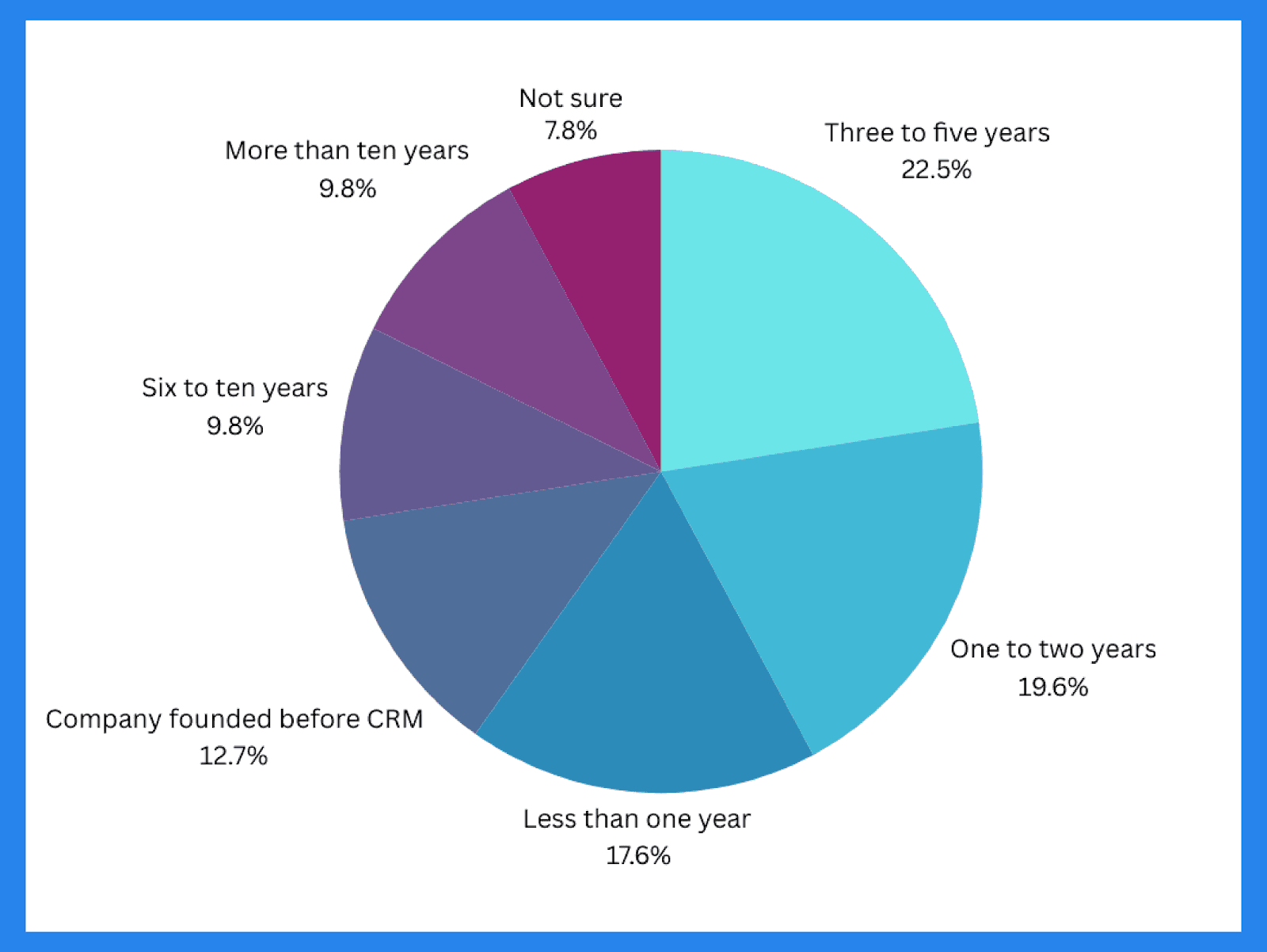
9. 65% of businesses started using a CRM within the first five years of starting their business (Source: answeriq).
10. And 50% of CRM projects fail because of a lack of cross-functional coordination (Source: answeriq).
11. In terms of overall CRM usage, Europe is one of the top regions in CRM adoption with a 85.7% adoption rate. America follows second largest with a 83.6% adoption rate (Source: answeriq).
12. 94% of tech companies and71% of small businesses use CRM systems to manage customer relationships and drive sales.
13. The retail industry has the highest CRM usage, with 18% of companies using it (Source: Zippia).
14. According to IDC, 79% of mid-market companies will rely on a CRM as their primary system of record by 2027, up from 64% in 2024 (Source: IDC).
Industry | Percentage of companies that use CRM |
|---|---|
Business Services | 10% |
Technology | 8% |
Banking/Insurance/Finance | 7% |
Manufacturing | 6% |
Others | 51% |
✔️ Benefits To Companies That Use CRM Statistics
15. Companies that use CRM systems have seen a 17% increase in lead conversions, a 16% boost in customer retention, and a 21% improvement in agent productivity (Source: WebFX).
16. Most businesses find that CRMs save their employees 5-10 hours per week (Source: Freshworks).
17. On average, CRM systems offer a return on investment (ROI) of $8.71 for every dollar spent (Source: Nucleus Research).
I might not be a numbers guy, but getting $8 back for every dollar spent sounds like a pretty good deal. That kind of ROI is only possible if you know how to maximize your CRM’s potential, so it can, in turn, maximize the potential of your leads.
18. In a study by Capterra, 45% of businesses said their sales revenue improved by using effective CRM software (Source: Capterra).
19. And 83% of SMBs cited customer relationship management software as both moderately and very effective in helping them achieve their marketing goals (Source: Capterra).
20. A CRM platform can boost revenue by 29%, increase forecasting accuracy by 32%, and productivity by 40% (source: Zippia).
CRM platforms come packed with tools and integrations designed to optimize your outbound sales efforts. From advanced analytics and intuitive pipeline automation to gamified features that spark friendly competition, the potential is vast. When leveraged effectively, increased ROI, better forecast accuracy, and higher productivity become standard outcomes.
21. Businesses that use CRM saw an increase of 41% in sales revenue and a 32% reduction in marketing costs (Source: LinkedIn).
22. A Forrester study found that organizations using AI-powered CRM workflows see a 25% lift in customer satisfaction scores and a 30% reduction in service costs (Source: Forrester Research).
🤖 AI in CRM Statistics (New for 2026)

23. Gartner predicts that by 2026, 60% of B2B sales organizations will transition from experience based selling to data driven selling, unifying sales processes, applications, data, and analytics into a single operational practice (Source: Gartner).
24. The global AI in CRM market was valued at around $4 billion in 2024 and is projected to reach $48.4 billion by 2033, growing at a CAGR of over 30% (Source: Fortune Business Insights).
25. According to McKinsey, generative AI applied to sales can deliver productivity gains worth 3% to 5% of current global sales spend, the equivalent of hundreds of billions of dollars in annual value (Source: McKinsey & Company).
26. A 2025 Deloitte study found that 73% of organizations are actively investing in AI for customer experience initiatives, up from 47% in 2022 (Source: Deloitte Insights).
27. Per LinkedIn’s State of Sales 2026 report, 78% of social sellers outperform peers who do not use social media, and 62% of buyers respond to sellers who reach out with insights and personalized content (Source: LinkedIn Sales Solutions).
28. Statista reports that spending on AI software will grow faster than any other software category through 2027, with CRM and customer experience platforms among the top three categories absorbing that growth (Source: Statista).
📈 CRM Market Share Statistics
29. CRM software revenue reached $48.7 billion in 2021, and it is projected to grow at a compound annual growth rate (CAGR) of 14.2% from 2021 to 2028 (Source: Grand View Research).
30. CRM is the largest and fastest-growing software market, with an expected global revenue of $114.4 billion by 2027 (Source: Adamenfroy).
The CRM market should comfortably exceed $114 billion by 2027, and AI will be a big reason why. The global AI market is set to keep expanding, and as it does, the CRM landscape will evolve right along with it. The headline market numbers only account for CRM advancements, not the AI-driven innovations layered on top. The rise of AI-native CRMs is going to be wild.
31. The global CRM industry is forecast to grow to $57 billion in size by 2025 (Source: Statista).
32. The CRM revenue has been forecast to increase to a total of £1.9 billion in the UK between 2024-2028 (Source: Statista).
33. The value of the U.S. CRM market is expected to grow at a CAGR of 12% from 2022 to 2030. If these numbers are to be believed, the market will be worth more than $42 billion by 2030 (Source: Zippia).
34. Fortune Business Insights projects the global CRM market to grow from $71.1 billion in 2024 to $157.6 billion by 2030, at a CAGR of around 12.6% (Source: Fortune Business Insights).
35. According to Mordor Intelligence, the multichannel CRM segment is the fastest-growing CRM category and is on track to surpass $20 billion in annual revenue by 2027, driven by AI-assisted inbox unification (Source: Mordor Intelligence).
❌ CRM Barriers To Entry Statistics
36. 20% of CRM users switched CRM systems because they found their CRM not user-friendly (Source: Capterra).
It’s not uncommon for users to feel that CRM platforms are anything but user-friendly. Trust me, I get it. Many major CRMs aim to be all-in-one solutions, packing in so many features that it can be overwhelming for first-time users. The result? Platforms overloaded with tools you may never use, making it difficult to focus on what actually matters: closing deals.
If you’re looking for a CRM that cuts through the BS and focuses on what really counts, check out our lightweight, deal-closing CRM built for 2026, not 2015.
37. 30% found their CRM tools inefficient (Source: Capterra).
38. 32% of CRM users feel a lack of technical expertise is the biggest roadblock (Source: fit small business). Here are other challenges small businesses face in adopting CRM software:
Cost of a CRM: 31%
Data migration issues: 30%
User adoption: 27%
Lack of app integrations: 23%
39. 20 to 70% of the CRM projects fail due to poor usage adoption (Source: Skuid).
Look, I get it. CRMs can be a handful to learn, even without all the unnecessary bloatware. That’s why at Breakcold, we’ve put together a comprehensive set of resources to help you get up to speed. From our demo video to a regularly updated resource library, we’ve got you covered. Rest assured, you’re in good hands when you choose Breakcold as your sales CRM.
40. 17% of businesses say manual data entry is their biggest CRM challenge (Source: Zippia). Other challenges include:
Manual data entry: 17%
Lack of integration with other tools: 17%
My sales team doesn’t use it: 16%
Don’t know or not applicable: 14%
Difficult to track my sales funnel: 12%
Invalid or incorrect data: 8%
It’s too complicated to use: 7%
Managers don’t use it: 5%
Other: 5%
What These CRM Statistics Mean For 2026 And Beyond
If you read the 40 numbers above and squint a little, four bigger patterns jump out. They are the actual story behind the headlines, and they should drive how you pick, set up, and use your next CRM.
1. AI is no longer a feature, it is the platform
Six of the 40 stats in this article are about AI inside CRM (stats 23 to 28), and they all point the same direction. Gartner is calling 60% of B2B sales orgs onto data driven selling by 2026. Fortune Business Insights has the AI in CRM market on track for $48.4B. McKinsey says generative AI in sales is worth 3% to 5% of global sales spend.
That is why the new generation of AI-native CRMs and CRMs built around AI agents is pulling away from the old guard. If you are picking a CRM in 2026, look for one where AI is the spine and not a paid add-on, and ideally one that exposes an MCP server so external agents like Claude or ChatGPT can plug in to your data.
2. Multichannel is the new baseline
70% of customers expect a seamless experience across channels (stat 9). Mordor Intelligence has the multichannel CRM segment as the fastest-growing CRM category (stat 35). LinkedIn’s State of Sales 2026 has 78% of social sellers outperforming peers who do not use social media (stat 27).
A CRM that only handles email in 2026 is, honestly, half a product. The growth is concentrated in LinkedIn-native CRMs and unified inbox tools that pull email, LinkedIn, WhatsApp, Telegram, and meetings into one record per contact.
3. Adoption friction is the real ROI killer
$8.71 returned per $1 spent (stat 17) sounds incredible, until you read that 20 to 70% of CRM projects fail because of poor user adoption (stat 39), and 30% of users find their CRM tools inefficient (stat 36). That ROI is conditional. It only materializes when your team actually uses the CRM every day, not when it sits there as expensive shelfware.
That is why CRMs aimed at small and mid-market teams, especially the ones built for sales teams from day one, tend to outperform enterprise-grade systems on real per-user ROI. Simpler tool, higher daily usage, better numbers.
4. Affordability finally caught up
Cost is now the second biggest barrier to CRM adoption (31% in stat 38’s sublist), nearly tied with data migration issues. That has reshaped the market in 2026: there is a clear wave of serious CRMs that cost under $100 per month for a small team, with AI features included rather than bolted on as an upcharge.
How To Use These CRM Statistics
These numbers are most useful when you put them to work. A few honest ways to do that in 2026:
Building a slide deck or board update: pair stat 17 ($8.71 ROI) with stat 22 (41% sales lift, 32% lower marketing costs) to defend or expand your CRM budget. Both numbers have clear, citable sources.
Pitching a CRM internally: open with stat 23 (Gartner’s 60% data driven selling prediction) and stat 25 (McKinsey’s productivity math). Decision makers respond to Gartner and McKinsey citations more than to vendor case studies.
Writing your own blog or LinkedIn post: pull the AI in CRM block (stats 23 to 28). All six come from non-vendor research firms (Gartner, Fortune Business Insights, McKinsey, Deloitte, LinkedIn Sales Solutions, Statista), so they hold up to scrutiny.
Picking your next CRM: treat stats 36 to 40 as your buyer checklist. Is the tool actually user-friendly. Will my team use it. What is the realistic cost vs the ROI math.
Methodology & Sources
Every stat in this article is linked back to its primary source. We prioritised independent research firms (Gartner, McKinsey, Forrester, Deloitte, IDC, Fortune Business Insights, Mordor Intelligence, Statista, Grand View Research, Nucleus Research) and respected aggregators (Capterra, DemandSage, SuperOffice, Zippia, WebFX). Where a single number is cited by multiple sources, we picked the most recent or the most rigorous one. The list is refreshed each quarter as new reports drop.
Final Thoughts
The headline of these 40 statistics is that the CRM market is bigger, faster-growing, and more AI-heavy than it was even a year ago. And that user adoption, or the lack of it, is still what decides whether you actually capture any of that promised ROI.
If you want a CRM that is built around AI and multichannel from the ground up rather than retrofitted, you can take Breakcold for a 2-week free trial. No credit card, no sales call. You can decide for yourself whether the stats above are playing out in your own pipeline.








![The 8 Best Social CRM Software in 2026 [Comparison]](https://framerusercontent.com/images/RYHyYapdgIi83BEWtMdX418.png?width=1280&height=720)
![The 6 Best LinkedIn CRM in 2026 [Comparison]](https://framerusercontent.com/images/Luywfni7ZKjb19yghbhNPy4I4qQ.png?width=1280&height=720)