



CRM for Startups: Don’t Scale WITHOUT These CRMs in 2026
TL;DR: the best CRM for startups in 2026 is the one your AI runs for you 🏆
🏆 Breakcold: the AI Native CRM for sales teams of 5 to 30+ people. AI agents handle the admin (move deals, log activity, create tasks), it connects to Claude and ChatGPT via native MCP, and it syncs LinkedIn, email, WhatsApp and Telegram into one pipeline. At 5 seats Breakcold is $139/mo, where a traditional CRM runs $300 to $500/mo.
🟢 HubSpot: generous free tier and a huge app ecosystem, but it gets expensive fast and adds admin work as you scale.
🔵 Pipedrive: a simple, affordable pipeline for calling-led outbound, but no native LinkedIn or WhatsApp and only light AI.
🟣 Attio: a flexible, modern data model for product-led startups that want to build their own CRM, at the cost of a steeper setup.
✅ How to choose: pick the CRM that removes data entry instead of adding it, covers the channels you actually sell on, and works with your AI tools. For most startups selling across LinkedIn and email, that points to an AI Native CRM like Breakcold.
Imagine you’re a startup founder juggling 20 tasks at once. A promising lead messages you on LinkedIn, another drops their email on your website, and a potential investor wants an update on your sales pipeline. By the end of the week, you’ve got sticky notes on your desk, half-updated spreadsheets, and a couple of follow-ups you forgot to send. Sound familiar?
This is exactly where a CRM (Customer Relationship Management system) comes in. Instead of scattered notes and missed opportunities, a CRM gives you one central place to manage leads, track conversations, and keep your team aligned.
For startups, getting a CRM in place early isn’t just about staying organized, it’s about setting the foundation for growth. In this guide, we’ll explore why startups need CRMs, the benefits they bring, common challenges without one, and the best CRM tools worth considering in 2026.
🧩 What Is a CRM for Startups?
A CRM** **helps startups track leads, manage contacts, and stay on top of sales. Unlike enterprise CRMs packed with complex features, startups need something simple, fast to set up, and easy for a small team to use. If you’re starting to lose track of leads or juggling too many spreadsheets, it’s time to get one.
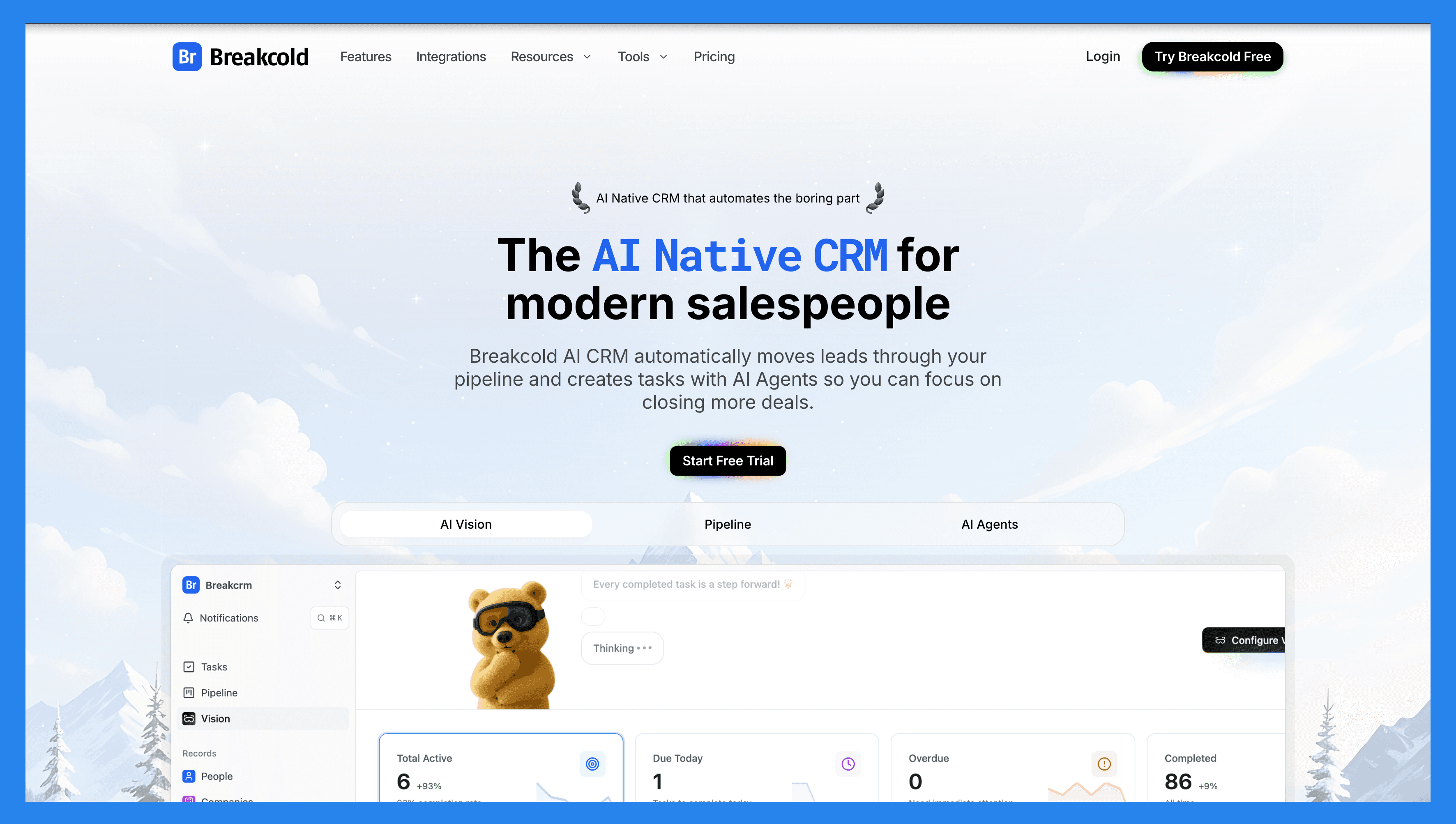
🥇 1. Breakcold: The CRM Where AI Agents Are Your First Hire
The Founder Reality Check
A 2 person founding team does not have an SDR. It has Cursor, Linear, Slack, 18 hour days and 6 deals in flight that no one has time to log. Most CRMs assume you have a rep to feed them data. Breakcold assumes you do not. That is the design point.
How Breakcold Acts Like a Hire
The product is built around three ideas that matter when the team is tiny. First, AI agents watch the inbox, the meetings and the LinkedIn DMs and update the CRM themselves. Second, the Vision Builder lets a founder describe a workflow in a voice note and have it built in seconds, no drag and drop diagram. Third, the native MCP server makes Claude or ChatGPT a first class CRM operator from day one. The Breakcold Agent Skill packages this into a one click setup. For the longer take on the AI as rep angle, read the CRM that removes admin work and the CRM that moves leads automatically.
Why Early Stage Startups Pick It
Bootstrapped founders care about cost per month and how fast a tool pays for itself. VC backed founders care about how the tool scales from 1 to 5 to 30 sellers without a migration. Breakcold fits both because the pricing is a single $99 plan plus $10 per extra seat, and the data model already supports custom objects and custom relations the day the team grows. See CRMs for early stage B2B startups for the VC angle and CRM for bootstrapped startups for the cost angle.
What You Actually Get
AI agents that update the CRM for you. Auto task creation, auto lead movement, lead scoring and CRM updates. The rep stops doing data entry because there is no rep.
Vision Builder for workflows. Describe what you want in plain text or voice. Breakcold builds it.
Native MCP server. Claude, ChatGPT, OpenClaw and other agents speak to the CRM directly. 54 tools. See the Breakcold MCP.
Multichannel inbox built in. Email, calls, meetings, LinkedIn, Telegram and WhatsApp all auto sync. Founders sell from wherever the prospect lives.
Custom objects and relations from day one. No migration when the team hits 10. Custom objects are first class.
Meeting recorder built in. Every demo and discovery call is transcribed and logged automatically. Founders stop forgetting what the prospect said.
Ratings
G2: 4.7 / 5 (116 reviews). Capterra: 4.8 / 5 (93 reviews).
What Works for Founders
The AI agent layer is the deepest of any CRM in this list. It is not a chat button bolted on the side.
Founder friendly pricing. Solo at $99, add a co founder for $10, never pay $100 per seat.
MCP support means the CRM grows with the agent stack the team will build anyway.
Onboarding library is built for non sales founders. Video, flowcharts, opinionated best practices.
What Does Not Yet
No native dialer. Integrate with Aircall if the team makes 100 calls a day.
Reporting is solid but not at the data warehouse plus BI tool level. Most early stage teams do not need that yet.
Younger third party ecosystem than legacy CRMs.
Founder Pricing Math
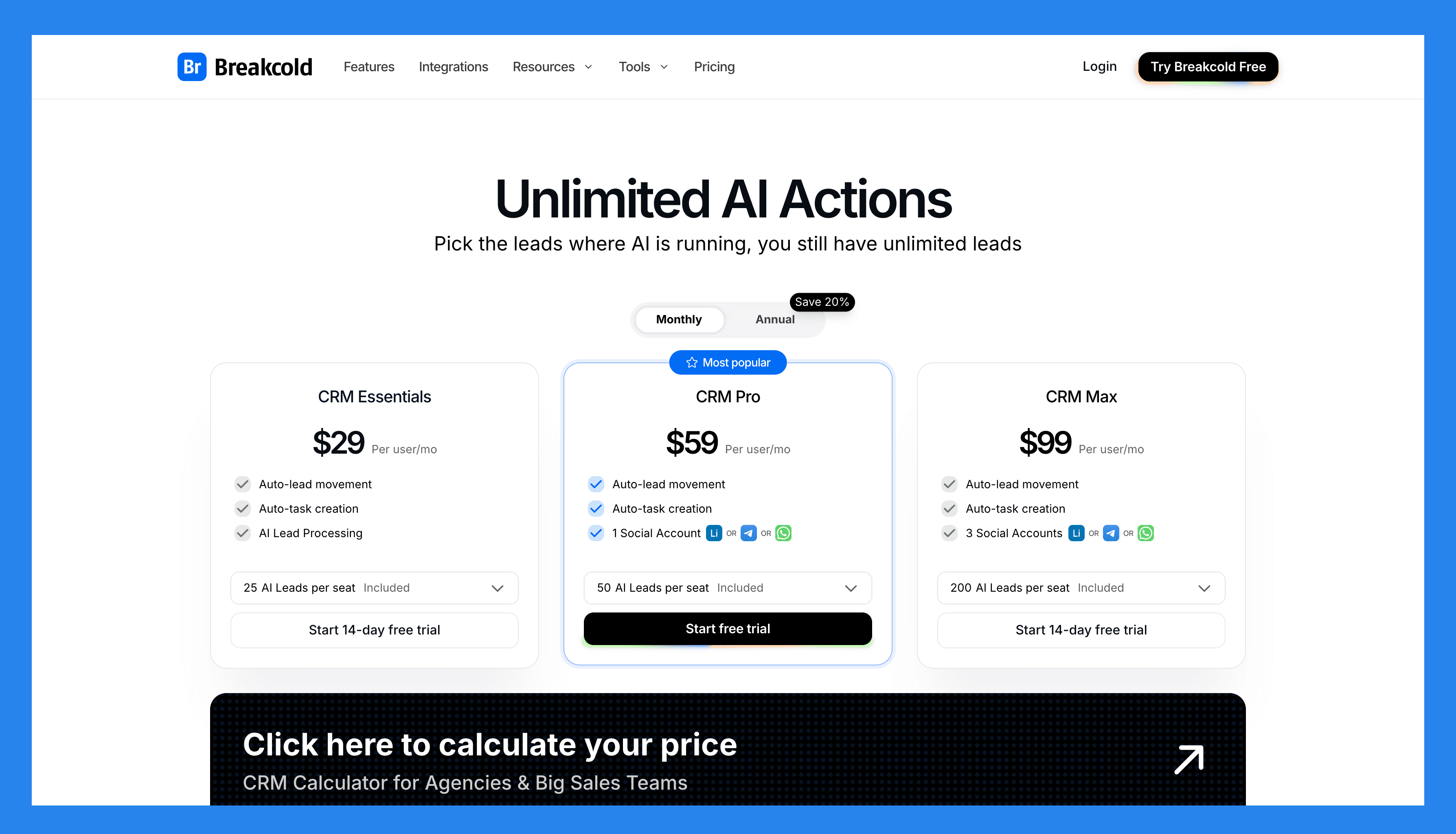
Solo founder: $99 a month. 1 seat, 2 social accounts, full product.
2 co founders plus 1 contractor: $99 + 2 x $10 = $119 a month.
Seed team of 10: $99 + 9 x $10 = $189 a month, still cheaper than 1 HubSpot Sales Hub Pro seat.
Tokens scale with AI use. An AI action burns roughly 0.5 tokens, an email waterfall request burns 10, a phone waterfall burns 80. Founders never pay for people or company enrichment.
A team of 5 on Breakcold is $139/mo, where Attio, Pipedrive and HubSpot Sales Hub run about $500/mo for 5 seats with similar features.
For the cross vendor price comparison see CRMs under $100 a month for small teams.
Demo Video
🥈 2. Attio - Best for Product-led Growth
Summary
Attio is the data first CRM that growth stage startups bring in when the founding team has outgrown a spreadsheet and started thinking about a real go to market function. The data model is the deepest in this category. The trade off is that it rewards a technical operator on the team.
Why Founders Pick It
VC backed startups with a technical founder pick Attio because it lets the team design the schema around how they actually sell, not around the CRM vendor opinion. Custom objects, relations, automations and a real API are all first class.
What Stands Out for Startups
Product like UX, fast keyboard navigation, clean object editor.
Generous free tier covering early experimentation.
Workflow builder, API access and SOC 2 ready governance.
Ratings
4.7 on G2 (around 1,044 reviews). 4.7 on Capterra (around 161 reviews).
What Works for Founders
Deepest data model of any modern CRM in this list.
Clean API and webhook surface that startup engineers actually enjoy.
Real free tier that scales the team for a quarter.
What Does Not Yet
Native multichannel sync is weaker than Breakcold. No native LinkedIn, WhatsApp or Telegram inbox.
Requires a technical operator or a free Sunday to set up well.
AI agent layer is younger than the product layer.
Founder Pricing Math
Free covers a founder team experimenting with the data model.
Plus at $34 a seat opens private lists, workflows and API access. Reasonable spot for a seed team.
Pro at $69 a seat adds advanced reporting and AI features. Enterprise pricing is custom.
🥉 3. Close – Best for Calling-Heavy Startups
Summary
Close is the call heavy CRM for startups that win on the phone, not on cold email or LinkedIn. Built in dialer, SMS and call recording sit at the center of the product. Founders selling into SMB or local business buyers like this stack.
Why Founders Pick It
A founder doing 50 calls a week wants a dialer that does not blink and a power dialer that compresses an afternoon of dials into an hour. Close does that better than anyone in this list.
What Stands Out for Startups
Native dialer, SMS and call recording.
Power dialer and predictive dialer for outbound heavy teams.
Email sequences and basic workflow automation.
Ratings
4.7 on G2 (around 1,114 reviews). 4.7 on Capterra (around 161 reviews).
What Works for Founders
Best in class telephony stack out of the box.
Fast onboarding for sales founders who already know the playbook.
Strong workflow primitives without becoming a HubSpot scale tool.
What Does Not Yet
No native LinkedIn, WhatsApp or Telegram inbox.
AI features are catching up but still trail multichannel AI native CRMs.
Pricing climbs fast once you outgrow the startup tier.
Founder Pricing Math
Startup tier at $49 a month for 1 user. Capped feature set, fine for a solo founder running phone outbound.
Professional at $99 a seat opens workflows, lead routing and SMS. Two founders land at $198 a month.
Enterprise in the $139 to $169 a seat range adds custom reporting and dedicated success.
4. Copper – Best for Google Workspace Users
Summary:
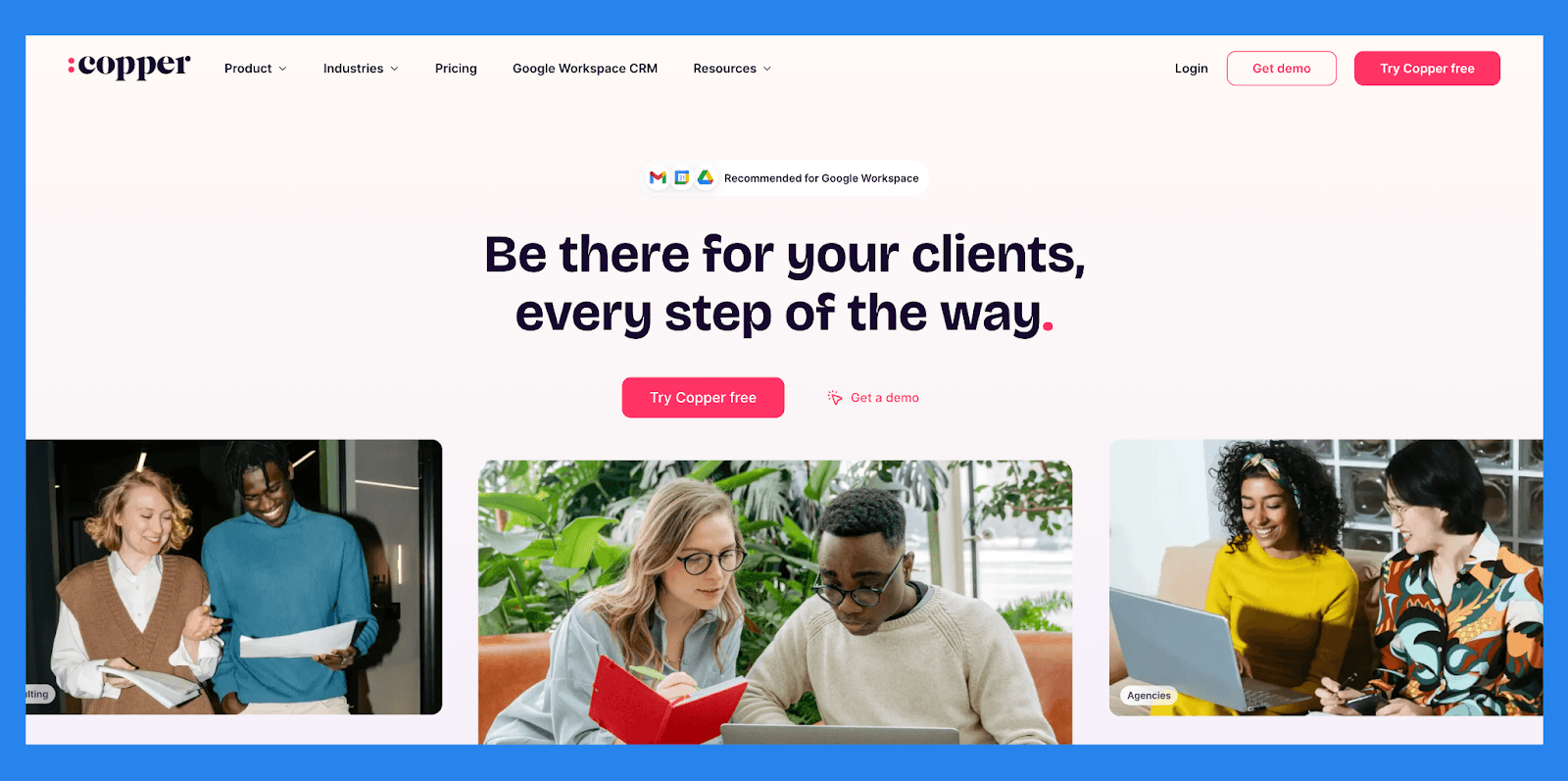
Copper CRM is the go-to choice for startups built around Google Workspace. With deep integrations across Gmail, Google Calendar, and Google Drive, Copper keeps all your CRM activity inside the tools your team already lives in. Its standout Chrome extension makes pipelines and contact data instantly accessible from your inbox, so you never have to switch tabs to stay on top of deals.
Why Startups Love It:
For founders and teams who rely heavily on Google Workspace, Copper feels less like an external CRM and more like a natural upgrade to their existing workflow. It’s lightweight, intuitive, and helps startups move fast without adding extra software overhead.
Ratings: G2 – 4.5/5 (1,135) · Capterra - 4.4/5 (619).
Pros
User-friendly interface with a low learning curve
Deep Google Workspace integration
Powerful Chrome extension for Gmail-based workflows
Automated workflows and smart reminders
Seamless data syncing across tools
Clean and intuitive mobile app
Cons
Occasional buggy performance
Limited compatibility with non-Google platforms
Customization options can be overwhelming for beginners
Pricing can be aggressive for smaller teams
Clunky API compared to more developer-friendly CRMs
Lacks scalability for larger organizations with complex needs
Pricing Plans
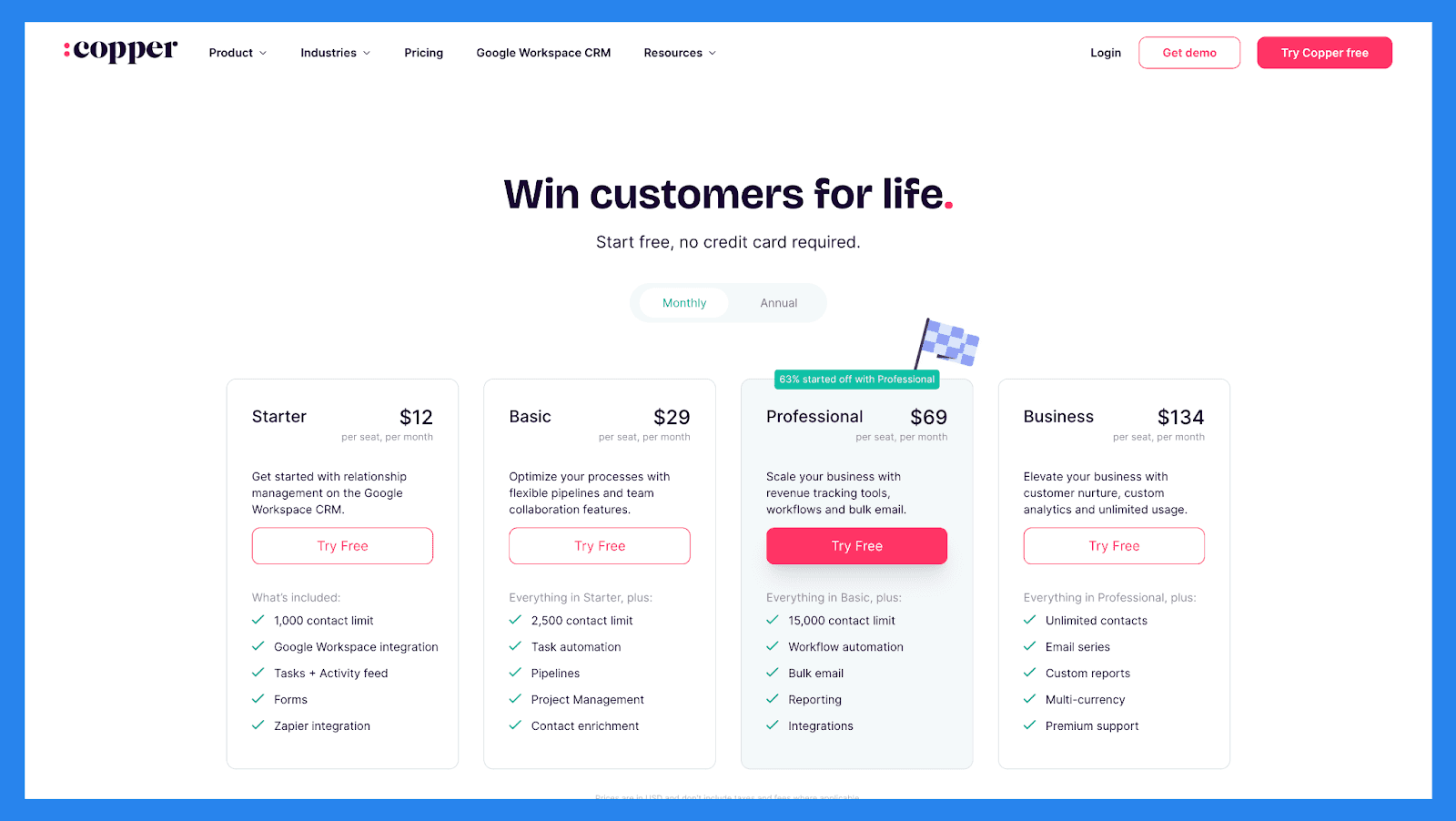
Starter ($12/user/mo): 1,000 contact limit, Google Workspace integration, Tasks + Activity feed, Forms. Plus 1 more.
Basic ($29/user/mo): everything in Starter, plus 2,500 contact limit, Task automation, Pipelines, Project Management. Plus 1 more.
Professional ($69/user/mo): 15,000 contact limit, Workflow automation, Bulk email, Reporting. Plus 1 more.
Business ($134/user/mo): everything in Professional, plus Unlimited contacts, Email series, Custom reports, Multi-currency. Plus 1 more.
5. Pipedrive – Best for Pipeline-Driven Startups
Summary
Pipedrive is the classic visual pipeline CRM. Clean stages, drag and drop deals, lightweight automation. Startups still pick it because the learning curve is short and the price tag at the bottom tier is friendly. The catch is that the AI and multichannel story has not kept up with newer CRMs.
Why Founders Pick It
Founders who lived inside Pipedrive at a previous job often default to it. The Kanban pipeline view is genuinely good and the basic CRM hygiene is easy to enforce on a 2 to 5 person team.
What Stands Out for Startups
Drag and drop pipeline view with stage automations.
Smart contact data with light enrichment.
Mobile app that founders actually use during travel.
Ratings
4.3 on G2 (around 1,900 reviews). 4.5 on Capterra (around 3,000 reviews).
What Works for Founders
Quick to onboard, minimal training for new sellers.
Cheap entry point for a solo founder running outbound.
Decent ecosystem of Zapier and Make automations.
What Does Not Yet
AI features are an add on, not native.
No native LinkedIn, WhatsApp or Telegram inbox.
No MCP server. Connecting Claude or ChatGPT requires custom glue.
Founder Pricing Math
Essential at $19 a seat is fine for a founder running a basic pipeline.
Advanced at $34 a seat opens email sync and the automation builder.
Professional at $64 a seat adds the AI assistant. Power and Enterprise add reporting depth most founders do not need yet.
6. Freshsales – Best for AI-Powered Sales Automation
Summary
Freshsales is the AI flavored CRM from Freshworks. It bundles a decent pipeline view with built in calling, email sequences and the Freddy AI scoring engine. Startups consider it when they want a one vendor stack but it is heavier than most early stage teams need.
Why Founders Pick It
Founders who want a single vendor for CRM, helpdesk and marketing automation pick the Freshworks stack. The AI scoring layer is genuinely useful once there is enough deal volume to feed it.
What Stands Out for Startups
Freddy AI for lead scoring and predictive insights.
Built in calling and email sequences.
Cross product integration with Freshdesk and Freshmarketer.
Ratings
4.5 on G2 (around 7,500 reviews). 4.5 on Capterra (around 600 reviews).
What Works for Founders
Strong AI scoring once data volume is meaningful.
Calling and email are first class, not an add on.
What Does Not Yet
No native LinkedIn, WhatsApp or Telegram sync.
Excels at email and calls but lacks meaningful social channel coverage.
Less suited to B2C use cases where company name is not the right key.
Founder Pricing Math
Growth at $35 a seat is the entry tier for a founding team of 2 or 3.
Pro at $55 a seat opens multi step workflows, custom dashboards and 500 email finding credits.
Enterprise at $115 a seat is overkill until Series A. Skip unless audit and migration support actually matter.
7. Day AI: Best Invite Only AI Native CRM for YC Style Startups
Summary
Day AI is one of the most talked about AI native CRMs inside the Y Combinator and SF ecosystem. The pitch is an autonomous CRM that listens to your meetings and emails, then writes the record for you. Access is limited and they grow mostly by word of mouth in restricted communities, so you may not be able to sign up the day you read this.
Why Startups Pick It
Founders who live on Zoom and email and want zero data entry like the idea of a CRM that builds itself from call recordings. If your sales motion is meeting heavy and you do not care about LinkedIn, Telegram or WhatsApp, Day AI is interesting. Compare with our CRMs with AI agents roundup.
Key Features
Auto generated CRM records from meeting transcripts and email threads.
AI summaries and follow up suggestions out of the box.
Strong Google Workspace and Zoom integration.
Opinionated, minimal UI built around the meeting log.
Ratings
G2: 4.8 / 5 (small sample). Capterra: not yet listed at scale.
Pros
One of the cleanest AI first onboarding experiences on the market.
Heavy automation around meeting capture and follow ups.
Loved by SF and YC backed startups with a Zoom heavy sales motion.
Cons
Limited access. You may need to sit on a waitlist.
Weak multichannel story. No native LinkedIn, WhatsApp or Telegram inbox.
Pipelines and custom objects are less flexible than what teams of 10 plus need.
Pricing is opaque compared to transparent AI sales CRMs with public pricing.
Pricing Plans
Free tier available for a single user with capped meeting capture.
Paid plans roughly start in the $40 to $60 per user per month range, billed annually, with usage based AI quotas.
Team and Enterprise pricing is custom and access is gated.
8. Streak – Best for Gmail-Driven Startups
Summary:
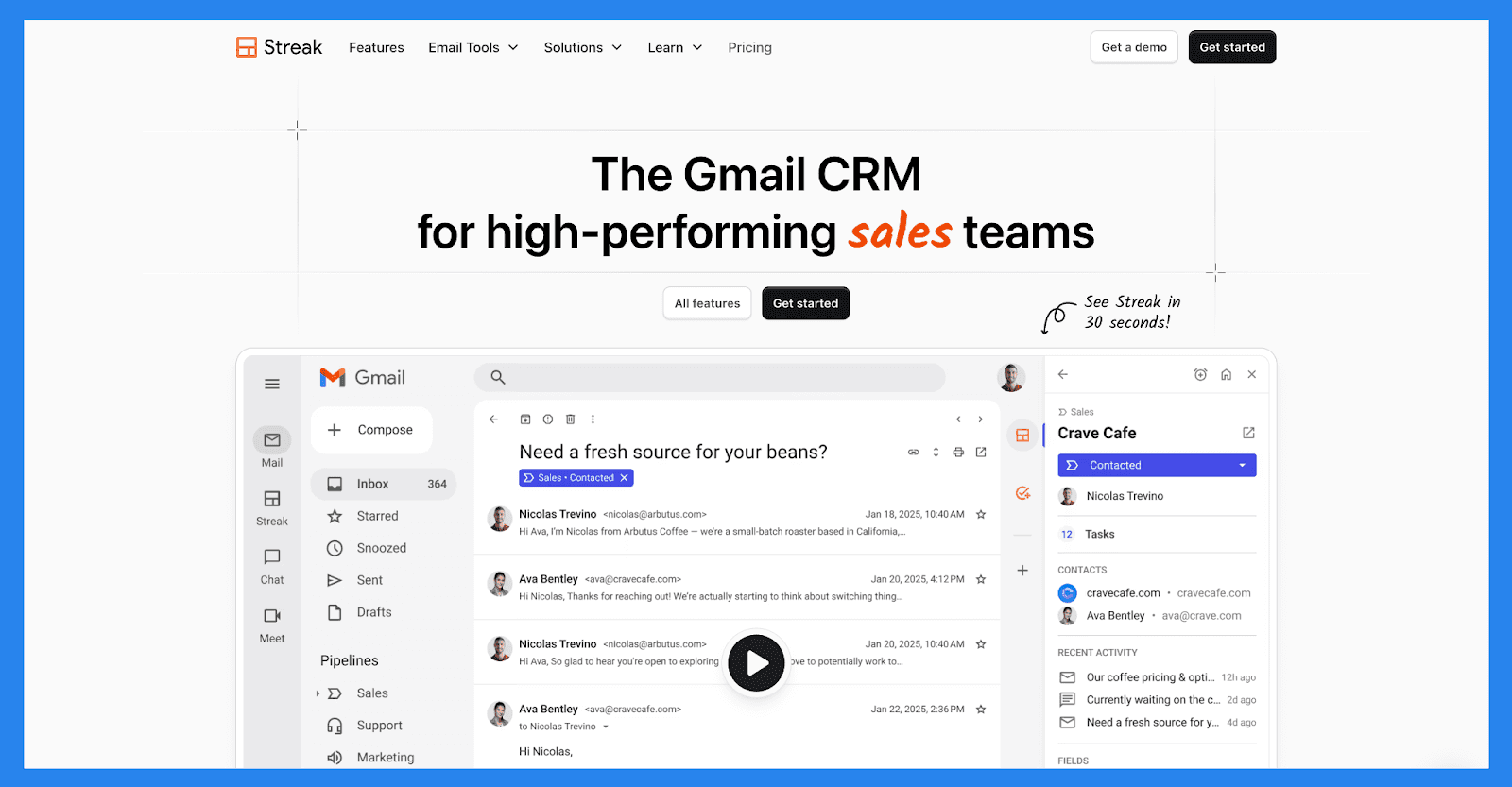
Streak is the only CRM built entirely inside Gmail, making it a perfect fit for startups that already run on Google Workspace. Instead of switching back and forth between your inbox and a separate CRM, Streak transforms Gmail into a full sales pipeline, complete with deal tracking, contact management, and collaboration tools. If your team knows how to use Gmail, you’ll know how to use Streak from day one.
Why Startups Love It:
For Gmail-driven startups, Streak removes the learning curve and tool overload. Founders and small teams get a lightweight, no-friction CRM that works seamlessly in their inbox, plus a mobile app that keeps customer data and call logs at their fingertips while on the move.
Ratings: G2 - 4.5/5 (250) · Capterra - 4.5/5 (480).
Pros
Streak + Gmail integration is really powerful. Nothing fancy needed, just set it up and you’re good to go.
Email tracking is extremely powerful, showing in real time when an email was opened, how long it was viewed, and if links were clicked.
Simple and easy conversation tracking keeps all communication organized.
Excellent onboarding support, the team is amazing and very helpful with setup if needed.
Cons
Templates need more work. Pipelines come ready, but optimizing them still takes a few extra steps, not just a one-click setup.
The initial learning curve can feel a bit challenging when you first start.
Pricing Plans
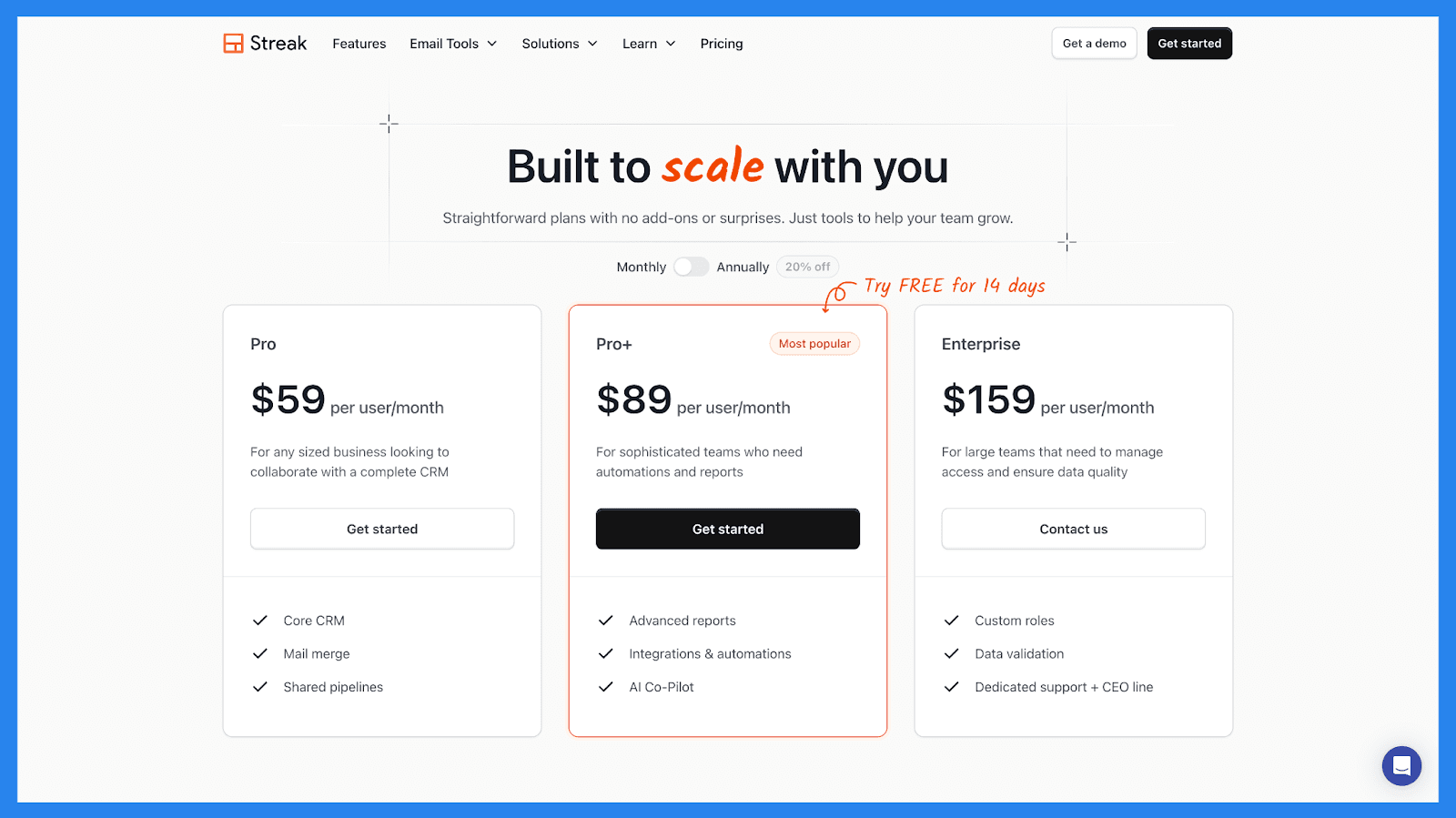
Pro ($59/user/mo): Core CRM, Mail merge, Shared pipelines.
Pro+ ($89/user/mo): everything in Pro, plus Advanced reports, Integrations & automations, AI Co-Pilot.
Enterprise ($159/user/mo): everything in Pro+, plus Custom roles, Data validation, Dedicated support + CEO line.
9. HubSpot CRM – Best Free Alternative for Scaling Startups
Summary
HubSpot is the default safe pick for startups that want a brand name CRM with a generous free tier. It scales from a solo founder up to a 200 person org, but the price ladder gets steep fast once you cross from Starter into Professional.
Why Founders Pick It
HubSpot Free CRM is genuinely useful for the first 6 to 12 months of a startup. Track contacts, deals and emails without a credit card. The bet is that by the time the team grows, switching costs lock you in.
What Stands Out for Startups
Free CRM with contact, deal and pipeline tracking.
Marketing, Sales and Service hubs that share the same record.
Vast ecosystem of integrations and consultants.
Ratings
4.4 on G2 (around 12,404 reviews). 4.5 on Capterra (around 4,362 reviews).
What Works for Founders
Best free tier of any CRM in this list.
Real reporting once you hit Professional.
Migrating in or out is well documented.
What Does Not Yet
Professional jumps from Starter at $20 to roughly $1,450 a month with 5 seats. Sticker shock is real.
AI features are catching up, MCP support is still missing.
No native LinkedIn, WhatsApp or Telegram sync.
Founder Pricing Math
Free CRM is the right slot for the first 6 to 12 months of a startup.
Starter Customer Platform at roughly $20 a seat adds Marketing, Sales and Service Hub starters.
Professional jumps to roughly $1,450 a month with 5 seats. Most YC startups outgrow it the year they hit Series A.
10. Folk: Best Notion Like CRM for Solo Founders
Summary
Folk repositioned from "Attio clone" to "Notion plus plus for solopreneurs and tiny teams." The product is clean, opinionated and friendly to founders who want CRM hygiene without learning a sales tool. The catch is the LinkedIn sync still requires manual clicks per conversation, while Breakcold auto syncs everything.
Why Founders Pick It
Solo founders who already love Notion default to Folk because the UI feels familiar. The Chrome extension makes adding LinkedIn contacts effortless. Stops being a fit once the team grows past 5 sellers.
What Stands Out for Startups
Notion style contact and deal views with template gallery.
Chrome extension for capturing LinkedIn profiles.
Light email sequencing and enrichment.
Ratings
4.6 on G2. 4.5 on Capterra.
What Works for Founders
Friendly UI that does not feel like a sales tool.
Good first CRM for solo founders and pre product market fit teams.
What Does Not Yet
LinkedIn, WhatsApp and Telegram conversations do not auto sync. You click per thread.
Pipelines are basic. Multi pipeline workflows get awkward.
No native MCP server. AI agent story trails newer modern AI native CRMs.
Founder Pricing Math
Standard at $25 a seat per month covers up to 2,000 contacts. Fine for a solo founder.
Premium at $45 a seat opens unlimited contacts and advanced enrichment.
3 person team lands at $135 a month with no AI agent layer to show for it.
Frequently asked questions

Written by
Arnaud Belinga · Co-Founder & CEO at Breakcold
Arnaud is the Co-Founder & CEO of Breakcold, the AI Native CRM for sales teams of 5 to 30+ people.