



CRM Automation in 2026: The 4 Tiers (Honest Guide)
TL;DR: CRM automation in 2026 in one minute 🏆
🏆 The big shift: CRM automation moved from "Zapier on top of a dumb CRM" to "AI agents running on top of an AI native CRM through MCP and a real API". If your CRM does not expose an MCP server in 2026, you are stuck on tier 1.
🟢 Tier 1 (legacy): Zapier, Make, Pabbly + webhooks. Still useful for niche jobs. Breaks all the time, costs add up, and the AI cannot reason over the data.
🔵 Tier 2 (native): built-in CRM rules. HubSpot workflows, Pipedrive automations. Better than Zapier, but still you-build-the-tree.
🟣 Tier 3 (AI inside the CRM): auto lead movement, auto task creation, AI suggested replies, AI dedup. Breakcold, Attio, Clarify run here. The CRM updates itself based on what your leads actually do.
🟠 Tier 4 (AI agents on MCP): an external AI agent (Claude, ChatGPT, Cursor, Claude Code) reads and writes your CRM through MCP, executes multi-step reports, finds stalled deals, drafts follow-ups, all on demand. Only a handful of CRMs ship this. Breakcold is the most open one.
CRM automation in 2026 is not what it was in 2024. The old definition was "wire your CRM to Zapier, push some webhooks around, and hope nothing breaks". That still works. But it is the bottom rung of what a modern sales team can do.
In 2026, the real CRM automation is AI agents that read your conversations, move leads through the pipeline, create tasks for you, and execute multi-step workflows across email, LinkedIn, WhatsApp, Telegram and meetings. The CRM is no longer a thing you fill in. It is a system your AI runs on your behalf.
This guide goes from the old definition to the new one in plain language: the 4 tiers of CRM automation, how each tier actually works in 2026, the concrete playbook every B2B team should ship, and the AI native CRM that does most of it out of the box.
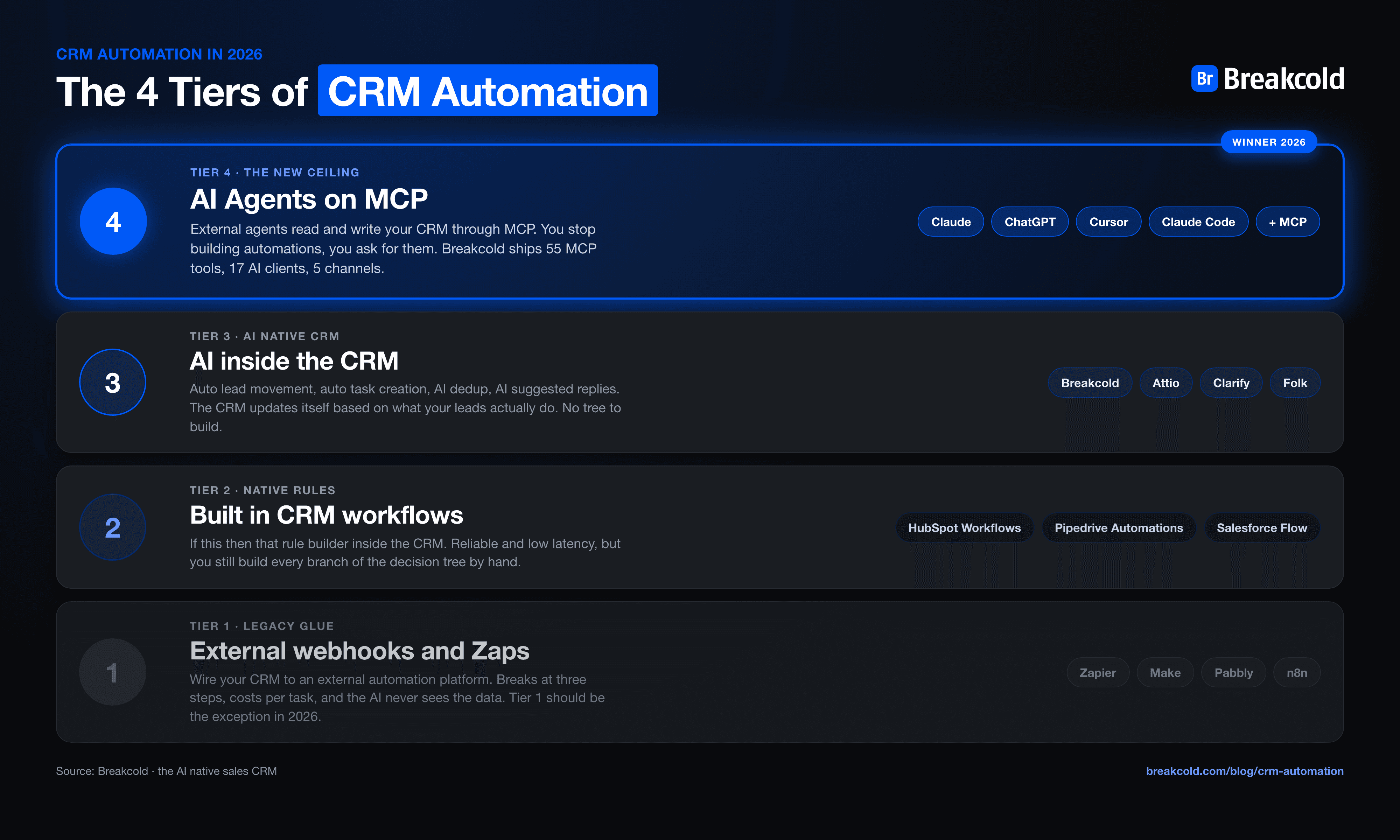
The 4 tiers of CRM automation in 2026
Most CRM automation guides on the internet still describe tier 1 only. That is the gap this article fixes. Here is how each tier actually works today.
Tier 1: Zapier, Make, Pabbly + webhooks (the legacy way)
This is the version of CRM automation everyone learned between 2018 and 2023. You hook your CRM up to an external automation platform (Zapier, Make, n8n, Pabbly), trigger on a webhook or a stage change, run a chain of "if this then that" steps, and push data around.
What it is still good for: connecting a tool that nobody bothered to write a native integration for. Pushing a Tally form submission into the CRM. Sending a Slack ping when a deal hits a specific stage. The kind of one-shot glue work that does not need to be smart.
Where it breaks: as soon as the workflow has more than 3 steps, you are debugging Zapier instead of selling. The bill grows quickly because every step is a task. The AI side is blind because the automation lives outside the CRM and the data only lands after the fact.
In 2026 this should be the exception, not the default. If you are building most of your CRM automation in Zapier, you are using the wrong CRM.
Tier 2: native CRM rules and workflows
Every modern CRM ships a built-in automation engine. HubSpot Workflows, Pipedrive Automations, Salesforce Flow, Attio Workflows, Breakcold AI Rules. You define triggers, conditions and actions inside the CRM and the engine handles the execution.
What it is good for: reliable, low-latency, predictable automations that stay inside the CRM and have access to the full record. Sending a sequence when a deal moves to a stage. Assigning a record to a rep based on territory. Creating a task at a specific date.
Where it breaks: you are still building the decision tree by hand. The more nuanced the trigger ("if the lead replied positively on LinkedIn but not yet on email, and the deal value is above $5k, then..."), the harder it is to express in a no-code builder. And the tree never adapts. A new edge case = a new branch.
Tier 3: AI driven automation inside the CRM
This is where the real shift started in 2024 and matured in 2026. The CRM ships AI features that observe what is happening across your conversations and records, and automate the boring parts without you defining a tree.
Concrete examples that already work in 2026:
Auto lead movement: the AI reads your conversations, understands that a lead just said "send me the contract", and moves the deal to Negotiation. You did not write a rule for that.
Auto task creation: the AI sees that a thread has been silent for 5 days and creates a follow-up task for you on the right date.
AI dedup: duplicate contacts are merged automatically.
AI suggested replies: next message drafted in your tone of voice and aware of the channel.
AI Personalities and AI Rules: a higher-level layer on top of the AI that lets you customize how aggressive it is, what it focuses on, and what it should never touch.
This is the layer where AI native CRMs like Breakcold pull ahead of HubSpot or Pipedrive. Legacy CRMs are bolting AI on top of a stack that was not designed for it. AI native CRMs treat the AI as the operator and the human as the editor.
Tier 4: external AI agents on MCP (the new ceiling)
This is the 2026 frontier. The CRM exposes an MCP server that an external AI agent (Claude, ChatGPT, Cursor, Claude Code, OpenClaw) can read from and write to. You then ask the agent to do things in natural language and it runs them across your entire CRM.
Examples a sales team is doing in 2026:
"Claude, find every deal in Negotiation that has not had a reply in 7 days and draft a follow-up DM based on the LinkedIn thread."
"ChatGPT, build me a one-page report on every prospect from last month tagged as ICP fit, including their LinkedIn engagement."
"Claude Code, write a script that pulls every deal closed last quarter and tags the channel that closed it."
This is not Zapier and it is not a workflow engine. It is the AI agent doing the work directly inside the CRM through a documented protocol. The catch: very few CRMs expose a working MCP server in 2026. Breakcold ships the most open one (55 tools, 17 AI clients, 5 channels including LinkedIn and WhatsApp). See the Claude integration shortlist for the rest of the field.
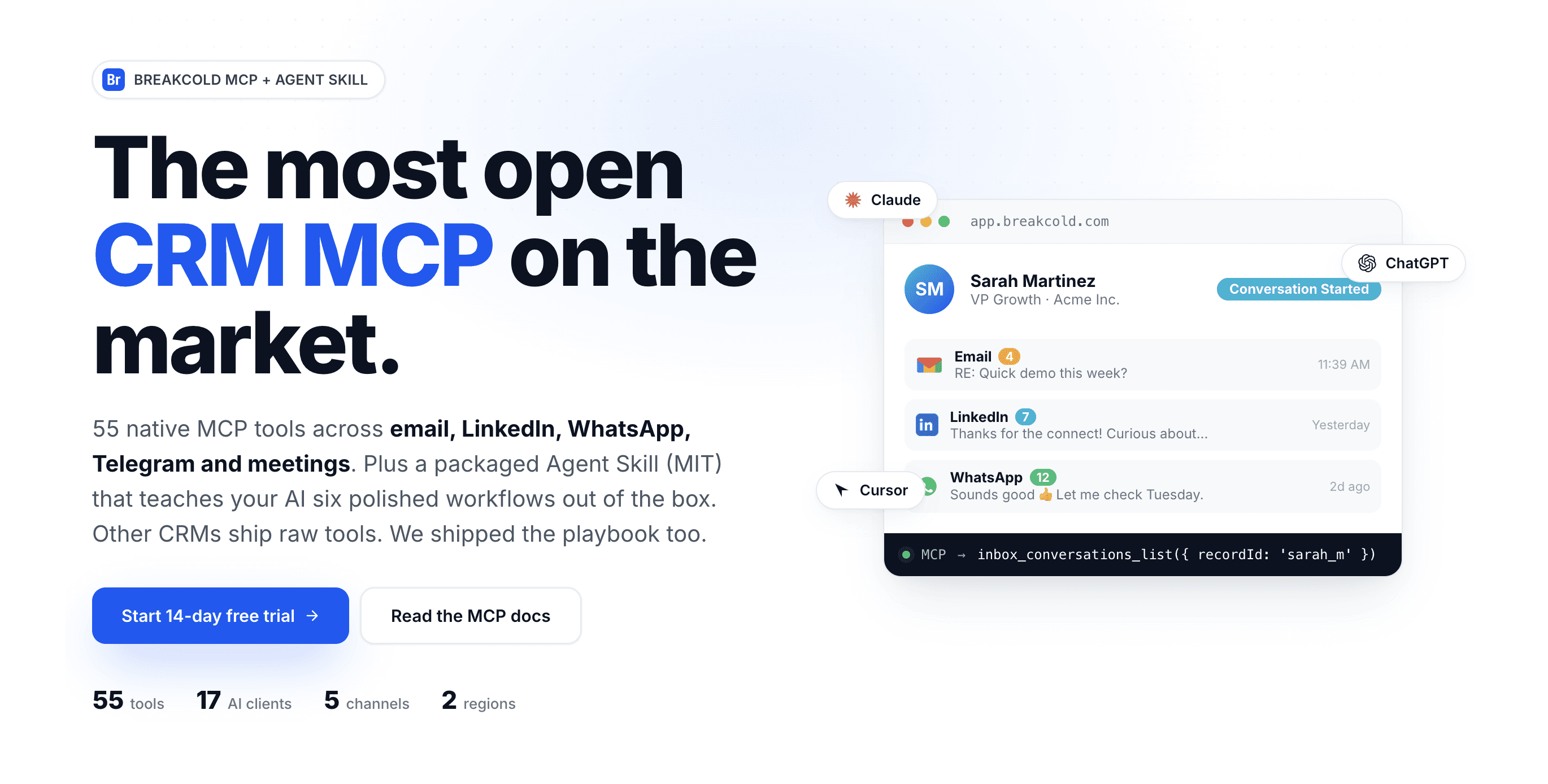
The 6 CRM automations every B2B team should ship in 2026
Forget the 30-step "ultimate playbook" lists. Here are the 6 automations that actually move revenue, in the order I would build them.
1. Auto-import positive replies from your cold email tool
If you run Smartlead, Instantly or any cold email platform, the moment a lead replies "interested", that lead should be in the CRM with a stage of "Interested", a source tag, and a follow-up task on the right rep.
Old way (tier 1): Smartlead webhook into Zapier into "create lead" into "create note" into "create task". Three Zapier tasks per reply, fragile, paid.
2026 way (tier 3): a native Smartlead, Instantly or Lemlist integration that the CRM understands out of the box. Breakcold, for example, ingests positive replies natively and auto-creates the contact, the note and the task. Zero glue.
2. Auto-move leads through the pipeline based on conversations
Lead said "send me a contract" on LinkedIn? Should be in Negotiation. Lead booked a Calendly? Should be in Discovery Call. Lead went silent for 14 days? Should be in Stalled.
Old way (tier 1 or 2): a Calendly webhook for the booking and a manual drag for the rest.
2026 way (tier 3): the AI reads every channel (email, LinkedIn, WhatsApp, Telegram, meetings) and moves the deal to the right stage automatically. This only works if the CRM has a multichannel inbox that natively syncs all of those channels. Most do not. See the LinkedIn CRM shortlist for who actually syncs LinkedIn DMs.
3. Auto-create follow-up tasks the rep cannot forget
Every silent thread is a leak. The AI should be watching every conversation and creating a follow-up task on the right day, on the right channel, for the right rep.
This is the single biggest revenue lift from CRM automation in 2026. Reps that adopt this stop losing deals to "I forgot to follow up". The CRM remembers for them.
4. Auto-enrich every new contact (email and phone)
Every new contact should arrive in the CRM with a verified work email, a phone number, a company name, a LinkedIn URL and an ICP tag.
Old way: glue BetterContact or FullEnrich on top with Zapier, pay an enrichment add-on, run out of credits.
2026 way: native waterfall enrichment inside the CRM. Breakcold ships BetterContact-powered enrichment as part of the standard plan with unlimited people and company enrichment at zero token cost.
5. Auto-notify on key deal events (closed-won, closed-lost, big stage moves)
Slack pings for closed-won are a classic for a reason: they keep morale high and help the team learn from wins. Same for closed-lost so the team can debrief.
In 2026 you do not need Zapier for this either. Most modern CRMs ship a native Slack integration that handles stage-change notifications directly.
6. Let an AI agent run the long-tail automations on demand
The 30 other things you used to build in Zapier ("when a contact's status changes to X, do Y, but only if Z, and skip if W"), in 2026 you just ask an AI agent on MCP to do them.
This is the part of CRM automation that most teams have not internalized yet. The point of MCP is that you stop building automations as a developer and start asking for them as a user. The agent reads the CRM, takes the action, writes a note, and tells you what it did. See the CRM AI agents overview for the deep dive.
Which CRM is best for automation in 2026?
This is where the article would normally turn into a 10-CRM comparison table. I will spare you that and give you the honest answer.
If you want all 4 tiers in one CRM: Breakcold. Native rules for tier 2, deep AI features for tier 3, a working MCP server with 55 tools for tier 4, plus native integrations to Clay, Smartlead, Instantly, Lemlist, HeyReach, BetterContact, Findymail, Fireflies and 20+ other tools so that tier 1 is barely needed. Multichannel coverage on email, LinkedIn, WhatsApp, Telegram and meetings means the AI has the full conversation in scope, not just email. One plan, $99 a month, $10 per extra seat. A team of 5 on Breakcold is $139/mo, where Attio, Pipedrive and HubSpot Sales Hub run about $500/mo for 5 seats with similar features.
If you have an ops engineer who wants to architect every step: Attio. Powerful workflows with AI filter blocks, deep data model, real API. Heavier to configure, no native LinkedIn or WhatsApp.
If you are still on HubSpot, Pipedrive or Salesforce: tier 1 and tier 2 are solid but you will struggle to reach tier 3 and tier 4. The AI features are bolted on, the MCP is limited or absent, and the pricing for "real automation" climbs fast. Worth reading the HubSpot alternatives and Pipedrive alternatives shortlists.
If you are evaluating Folk, Clarify, Day AI or Lightfield: they all sit in tier 3 with limited tier 4. Narrower integration sets and channel coverage than Breakcold. They are real options if your use case fits their scope.
Common mistakes teams make with CRM automation
Mistake 1: building tier 1 Zapier flows on top of a CRM that already does it natively. Every Zap you build is technical debt. Check the CRM's native integration list first.
Mistake 2: automating data entry but not the next action. A CRM that auto-creates a contact but does not also create the follow-up task is half-automated. The whole point is to remove the rep's admin work end to end.
Mistake 3: ignoring LinkedIn, WhatsApp and Telegram. If your CRM only automates email, your AI is reasoning over half the conversation. The result is a confused pipeline.
Mistake 4: not exposing the CRM to an AI agent. In 2026 the biggest unlock is letting Claude or ChatGPT operate your CRM through MCP. Teams that skip this stay stuck in tier 2.
Mistake 5: optimizing automations for the rep instead of the team. Solo workflows are fine. The compounding value comes from team-wide rules: shared pipelines, shared roles, shared follow-up logic. See the CRM for sales teams piece for how to think about this.
Verdict: stop building automations, start asking for them
The mindset shift for CRM automation in 2026 is simple. You stop being a builder of decision trees and start being an operator of an AI that handles the CRM for you.
The legacy CRMs (HubSpot, Pipedrive, Salesforce) and the legacy automation tools (Zapier, Make, Pabbly) still have a place. They are the bottom two tiers. They will not go away. But if you spend your week in them in 2026, you are paying a tax that newer teams stopped paying.
The right move is to put the CRM on tier 3 and 4 by default: pick an AI native CRM with native integrations to your stack, native AI inside the product, and a working MCP server on top. Breakcold is the cleanest path to all of it today, and the standard 14-day free trial covers every feature mentioned in this article.
\
Frequently asked questions

Written by
Arnaud Belinga · Co-Founder & CEO at Breakcold
Arnaud is the Co-Founder & CEO of Breakcold, the AI Native CRM for sales teams of 5 to 30+ people.