



The 7 Best CRMs for Teams of 5 to 30 People in 2026
Breakcold is the only CRM designed specifically for this bracket. The other 6 can work, with caveats you should know before you sign up.
TL;DR: the best CRMs for teams of 5 to 30 people in 2026 🏆
🏆 Breakcold: the AI Native CRM for sales teams of 5 to 30+ people. AI agents handle the admin (move deals, log activity, create tasks), it connects to Claude and ChatGPT via native MCP, and it syncs LinkedIn, email, WhatsApp and Telegram into one pipeline. At 5 seats Breakcold is $139/mo, where a traditional CRM runs $300 to $500/mo.
🔵 Pipedrive: a clean visual pipeline that still works for email first teams, but LinkedIn needs a third party connector and the AI is surface level.
🟠 HubSpot: worth the cost only if you need marketing automation alongside sales, otherwise Sales Hub is expensive and admin heavy at this size.
🟢 Close: hard to beat for phone led teams thanks to native dialer and call logging, but no native LinkedIn, WhatsApp or Telegram.
🟣 Attio: the most powerful data model here, best for a technical team that will configure it, though it keeps drifting upmarket.
✅ How to choose: pick the CRM that matches your primary channel and does not need a dedicated admin. For multichannel outbound teams that want AI to handle the busywork, that points to an AI Native CRM like Breakcold.
There is a specific company size that basically every CRM listicle gets wrong. Not solopreneurs. Not enterprises. The 5 to 30 person bracket.
If you are running a sales team of 8 people, or a startup with 15 reps, or an agency with 20 clients to manage, you are in a frustrating no-man's land. You are too big for the "simple tools for freelancers" category, and too small (or too lean) to justify a $100 per seat per month enterprise platform that needs a dedicated admin to configure.
Most CRM advice either ignores this bracket entirely or lumps it into "small business CRM" next to a solopreneur with a spreadsheet. So I put together a proper list: 7 CRMs that can realistically serve sales teams in this size range, ranked honestly by how well they actually fit.
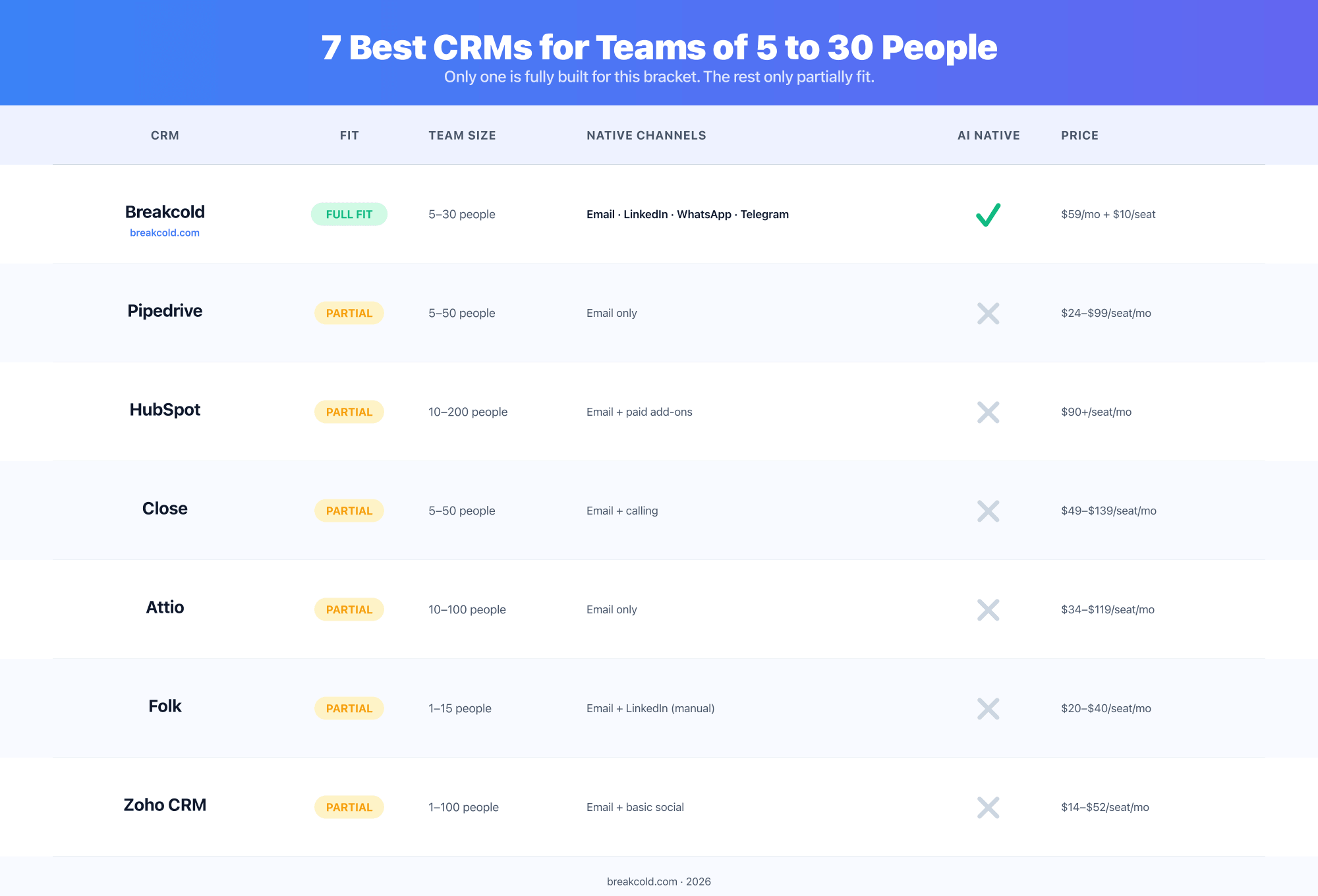
Quick note on the scoring: only one CRM on this list was explicitly built for 5 to 30 people. The others can work, but with caveats you should know before you sign up.
1. Breakcold: The only CRM built specifically for this bracket 🎯
I am biased here, obviously. But bear with me because the argument is structural, not self-promotional.
Breakcold was designed with one ICP in mind: sales teams of 5 to 30 people at startups, agencies, and consulting firms. Not solopreneurs (though they use it), not enterprises (though some do). The pricing, the features, the channel coverage, and the AI layer were all built for that exact bracket.
The strongest argument for Breakcold in this size range comes down to three things most CRMs miss:
First, native multichannel without add-ons. At 5 to 30 people, your sales reps are not just sending emails. They are prospecting on LinkedIn, closing deals on WhatsApp, following up on Telegram. Breakcold is the only CRM that natively syncs all of these into one inbox without paying for third-party connectors. Email, LinkedIn DMs, WhatsApp, Telegram, calls, meetings: all in the same feed, auto-synced, no clicking to import.
Second, pricing that makes sense for this headcount. The base plan is $99/mo, and each additional seat costs $10/mo, not $59 or $99. A team of 5 on Breakcold is $139/mo, where Attio, Pipedrive and HubSpot Sales Hub run about $500/mo for 5 seats with similar features. A team of 10 on Breakcold costs $189/mo. That same team on HubSpot Sales Hub Professional would cost over $1,000/mo. The math is not subtle.
Third, AI-native design that actually reduces admin. Most CRMs bolted AI onto an existing product. Breakcold built around it: AI CRM actions, auto-task creation, Claude and ChatGPT integrations, and an MCP server so your AI agents can read and write your CRM data directly. For a team of 5 to 30 without a dedicated RevOps hire, this matters a lot.
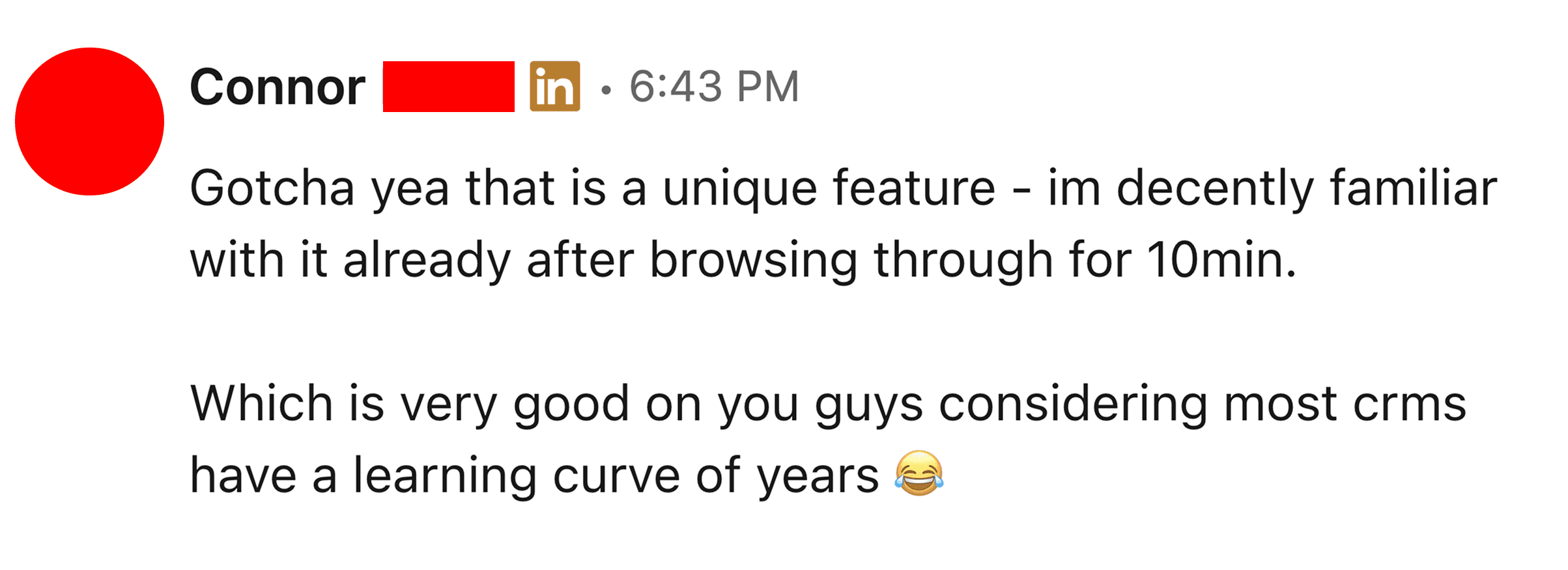
No learning curve. Connor had a solid read of the platform after 10 minutes, which is rare at this feature depth.
The roles and permissions system means multiple team members can engage from shared inboxes without stepping on each other. Agencies love this because they can run separate workspaces for separate clients on one account.
Best for: Teams of 5 to 30 doing outbound sales with LinkedIn, WhatsApp, or Telegram as part of the workflow. Also strong for agencies managing multiple clients.
Limitations: Not a replacement for HubSpot's marketing automation if you need drip campaigns, landing pages, or email sequences at scale.
Price: $99/mo base, $10/mo per additional seat. Unlimited contacts, pipelines, custom objects, and enrichment.
2. Pipedrive: The OG SMB CRM, but not what it used to be 📉
Pipedrive was, for a long time, the default recommendation for sales teams of this size. It pioneered the visual pipeline interface, had clean onboarding, and was genuinely loved by SMB sales reps through most of the 2010s.
Then in 2020 it was acquired by a private equity firm. Since then, look at the G2 reviews or any community forum and you will see the same pattern: pricing crept up, features got paywalled, the AI layer feels like an afterthought (mostly summaries, nothing structural), and LinkedIn integration requires paying for a third-party connector.
Pipedrive still works for teams of 5 to 30, especially if email is your primary channel and you do not need LinkedIn selling or WhatsApp workflows. The pipeline UI remains one of the cleaner ones on the market. But the days of it being the obvious choice are over.
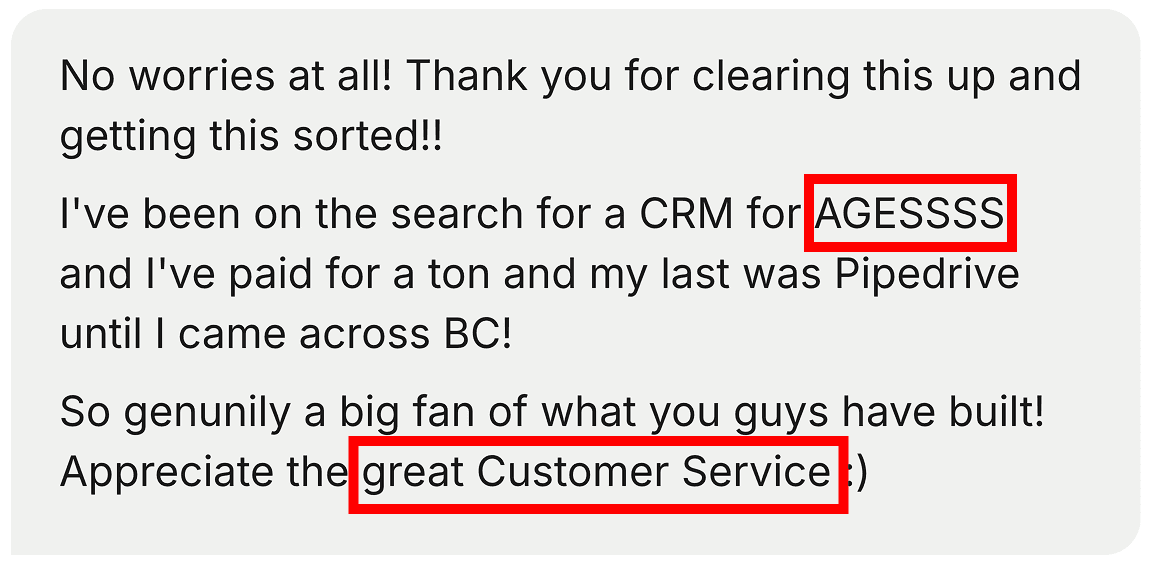
A recurring pattern in Breakcold signups: teams that tried Pipedrive and wanted something more adapted to how sales actually happens in 2026.
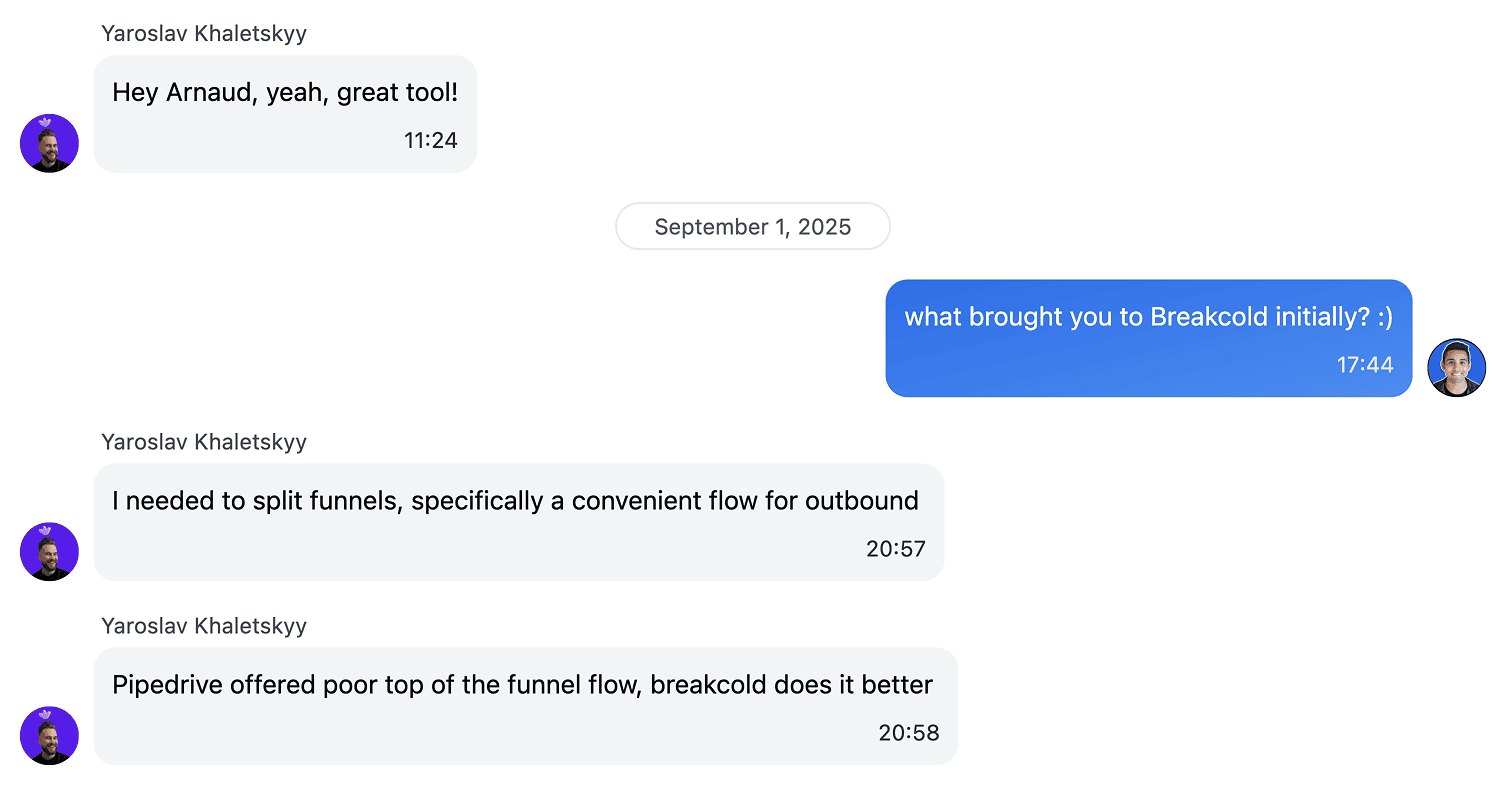
For outbound-heavy teams, Pipedrive's top-of-funnel experience has aged poorly. Multi-pipeline workflows in particular are clunky.
If you are coming from Pipedrive and want an upgrade designed for modern outbound, check out this dedicated comparison: AI CRM alternatives to Pipedrive in 2026.
Best for: Email-first sales teams of 5 to 50 people who want a clean pipeline without heavy configuration. Works well if your reps never need LinkedIn or WhatsApp workflows.
Limitations: LinkedIn integration requires add-ons or third-party tools like Surfe. AI features are surface-level. Pricing can climb fast once you add marketplace integrations.
Price: $24 to $99/seat/mo depending on plan. Certain automations and AI features gated to higher tiers.
3. HubSpot: Powerful, recognizable, but expensive for this size 💸
HubSpot is the default enterprise recommendation that somehow crept into SMB conversations. The brand recognition is real: everyone has heard of it, your prospects have heard of it, and the onboarding experience is polished. For marketing-led teams, HubSpot's CMS, email sequences, and lead nurturing tools are genuinely strong.
For a pure sales team of 5 to 30 people though, HubSpot is usually overkill and overpriced. Sales Hub Professional starts at around $90 per seat per month. A team of 10 is spending $900/mo before you add LinkedIn, enrichment, or any meaningful AI. These are things Breakcold bundles at the base plan.
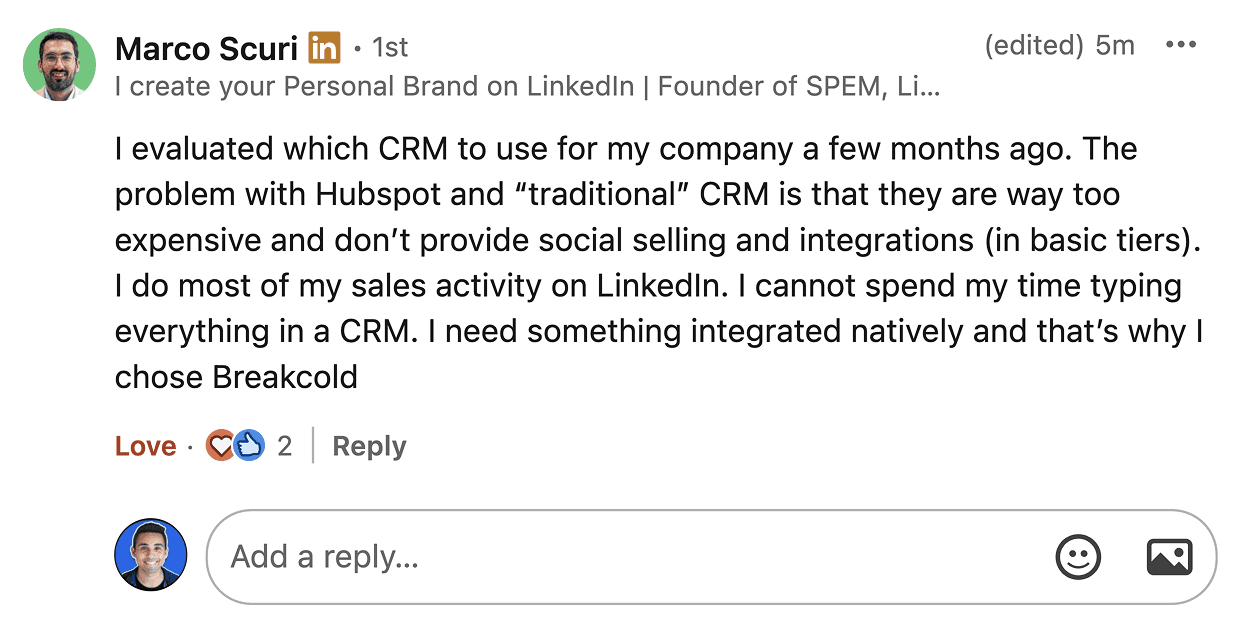
Marco Scuri (personal branding founder) explains the HubSpot problem clearly: the price, the lack of native LinkedIn selling, and the manual data entry that comes with "traditional" CRM design.
Where HubSpot genuinely earns its place for 5 to 30 people is when the team is equally marketing and sales: you want automated nurture sequences, landing pages, a blog, AND a pipeline all in one place. If that is your situation, HubSpot is worth the cost. If you are pure sales, it probably is not.
For a deeper breakdown: AI CRM alternatives to HubSpot that cost less.
Best for: Marketing-plus-sales teams of 10 to 200 people where the CMS, email marketing, and pipeline all need to live in one platform. Strong brand recognition if you need management buy-in.
Limitations: Very expensive for the sales-only use case. LinkedIn and multichannel selling require paid integrations. The admin surface is enormous for a team of 5 to 30.
Price: Sales Hub Starter from $20/seat/mo, Professional from $90/seat/mo. Enrichment and AI tools are separate add-ons.
4. Close: The best CRM for calling-first sales teams 📞
Close grew out of the YC community and built one of the strongest calling experiences in the CRM market. Native VoIP, call recording, automatic call logging, SMS: if your sales process runs on the phone, Close is genuinely difficult to beat.
It has also managed to integrate with AI tools reasonably well for a traditional CRM: call summaries, email sequence automation, and a set of integrations that work without much friction. The customer base is loyal, many of them staying despite considering alternatives because the calling features are that good.
For a team of 5 to 30 doing heavy phone outbound, Close fits this bracket well. The limitation is that it stops there: no native LinkedIn sync, no WhatsApp, no Telegram. If your reps are also selling on LinkedIn, you will be stitching together third-party tools.
Best for: Sales teams of 5 to 50 where calling is the primary channel. Strong fit for SaaS companies doing inbound demo calls, or outbound teams running phone-first sequences.
Limitations: No native LinkedIn, WhatsApp, or Telegram. LinkedIn selling and LinkedIn CRM workflows require third-party add-ons. Gets expensive at scale.
Price: $49 to $139/seat/mo. VoIP calls included in most plans.
5. Attio: Technically impressive, but drifting upmarket 🏗️
Attio has the most powerful data model on this list. Custom objects, custom relations, computed fields, real-time sync: if you have a GTM engineer or a technical ops person who wants to build a bespoke CRM experience, Attio gives you the scaffolding to do it.
The problem for a team of 5 to 30 is that Attio is visibly moving upmarket. The product is increasingly built for larger organizations with dedicated RevOps functions. In 2025 and into 2026, the pricing and positioning both shifted toward 50-plus person teams. For a 10-person sales team that just wants to track deals and not become a CRM expert, Attio has become more configuration than most teams want to do.
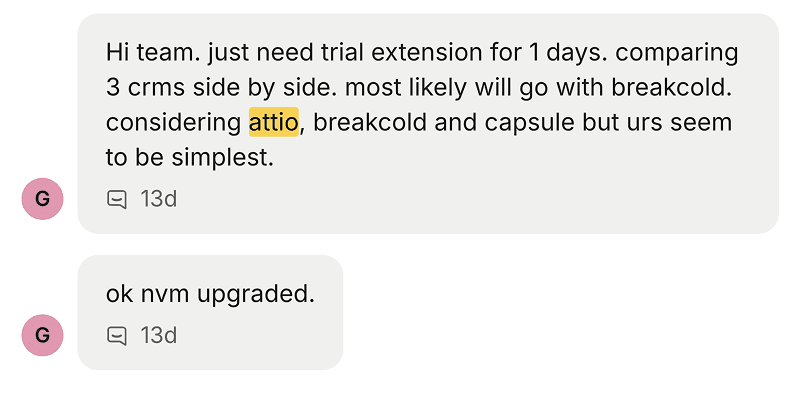
A common evaluation pattern: Attio is technically impressive but the complexity tips many teams toward something simpler at this size. This user compared three CRMs and upgraded to Breakcold on the spot.
Worth noting: Attio's data model is genuinely strong, and Breakcold's data model is the closest thing to it for SMBs. You are not sacrificing depth by choosing Breakcold; you are choosing the version designed for your team size. For a full look: Attio alternatives ranked for 2026.
Best for: Tech-heavy teams of 10 to 100+ where someone will configure and maintain a custom data model. Excellent for ops-driven organizations.
Limitations: No native LinkedIn sync, no WhatsApp or Telegram. Requires investment in setup. Pricing and complexity both increasing as they go upmarket.
Price: $34 to $119/seat/mo. Free tier available but limited.
6. Folk: Clean and simple, but built for solopreneurs 🤝
Folk has done a good job positioning itself as a modern, Notion-inspired CRM. The UI is genuinely clean, the onboarding is fast, and for relationship-driven businesses at the smaller end of this bracket (5 to 10 people), it can work.
The issue I keep running into is that Folk is fundamentally a solopreneur product that has been stretched toward small teams. The LinkedIn integration, which they market heavily, requires manual steps to sync conversations: you click a button in their Chrome extension to push each conversation to Folk. Breakcold does this automatically in the background. At 5 people this is an annoyance. At 15 or 20 reps, it breaks the workflow.
I have also never, in multiple years of watching the CRM space, heard someone say "I love Folk." The CEO tried Breakcold with multiple accounts, which tells you something about how they see the competitive landscape.
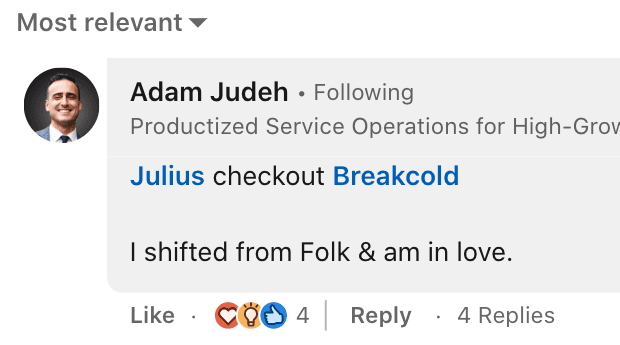
Adam Judeh, who runs a productized service operation, shifted from Folk to Breakcold and described being "in love." The pattern recurs often among teams that outgrow Folk.
For teams of 5 to 30 that want Folk-level simplicity with actual multichannel sync, there are stronger alternatives.
Best for: Solopreneurs and very small teams (1 to 10 people) doing relationship-driven outreach where simplicity matters more than channel depth.
Limitations: LinkedIn sync is manual, not automatic. No WhatsApp or Telegram. Scales awkwardly past 10 people. Limited AI depth.
Price: $20 to $40/seat/mo.
7. Zoho CRM: The affordable traditional option 🏛️
Zoho CRM is one of the few traditional CRMs that has stayed genuinely affordable for teams of 5 to 30. It covers the basics well: pipelines, contacts, email sync, basic automations, and a reporting layer that scales to medium-complexity use cases. The Zoho ecosystem is also deep: if you already use Zoho Books, Zoho Desk, or Zoho Campaigns, the CRM slots in without much friction.
The honest critique is that Zoho has not evolved as fast as the channels sales teams actually use today. LinkedIn and WhatsApp integrations are available but feel bolted on. The UI has improved but still carries the weight of a platform built in an earlier era of SaaS. The AI layer (Zia) exists but is not meaningfully integrated into the sales workflow the way native-AI CRMs are.
That said, for a budget-conscious team that needs a solid, reliable CRM without a lot of experimentation, Zoho is a reasonable pick. It also works well for teams in markets where HubSpot or Salesforce are overcomplicated and overpriced, but the team still wants more structure than a spreadsheet.
Best for: Cost-conscious teams of 5 to 30 that want a structured CRM with reasonable automations and are already in the Zoho ecosystem. Good for teams where email is the primary channel and LinkedIn/WhatsApp are not part of the core workflow.
Limitations: UI feels dated compared to newer CRMs. LinkedIn selling and LinkedIn workflows require add-ons. AI features (Zia) are limited compared to natively AI-built platforms. Not ideal for multichannel prospecting.
Price: $14 to $52/seat/mo. Free plan available up to 3 users.
The real question: what does your team actually do? 🎯
Every CRM on this list can technically serve teams of 5 to 30. The gap is in how well they fit what sales teams in this bracket actually do in 2026.
If your reps are on LinkedIn every day, closing deals over WhatsApp, and you want AI agents handling the admin while they sell: Breakcold is the only one built for that workflow from the ground up.
If calling is your primary channel: Close is hard to beat.
If you need marketing automation alongside sales: HubSpot, at a higher cost.
If you want a technical, flexible data model and have someone to configure it: Attio, while it still targets your size.
If budget is the primary constraint and email is the main channel: Zoho or Pipedrive, with the caveats above.
For teams in this bracket trying to keep CRM costs under $100/mo total, Breakcold is genuinely the only option that gives you full multichannel coverage, AI workflows, custom objects, and unlimited contacts at that price point.
One last thing worth knowing: several people from HubSpot, Attio, Salesforce, and Pipedrive have signed up for Breakcold accounts. When the competition comes to try your product, you are probably doing something right.
If you want to see where Breakcold fits in the broader AI-native CRM landscape, or compare it against specific tools, the agency-focused CRM guide is a good next read.
Frequently asked questions

Written by
Arnaud Belinga · Co-Founder & CEO at Breakcold
Arnaud is the Co-Founder & CEO of Breakcold, the AI Native CRM for sales teams of 5 to 30+ people.